







Enterprises should look for a platform that can manage the full journey from raw usage data to an accurate invoice. This includes usage mediation, real-time and batch rating, flexible pricing configuration, contract enforcement, invoicing, financial controls, and integration with the wider quote-to-cash ecosystem.
The platform should also support high event volumes, customer-specific agreements, complete traceability, and subscription, usage-based, and hybrid pricing models within the same environment. Just as importantly, it should allow pricing and product teams to introduce changes without requiring the billing architecture to be rebuilt each time.
LogiSense is designed for organizations where usage is a significant source of revenue and billing accuracy, flexibility, auditability, and scale are essential.
Built to handle the billing complexity that everything else was never designed for
Enterprise billing built for the way revenue actually works
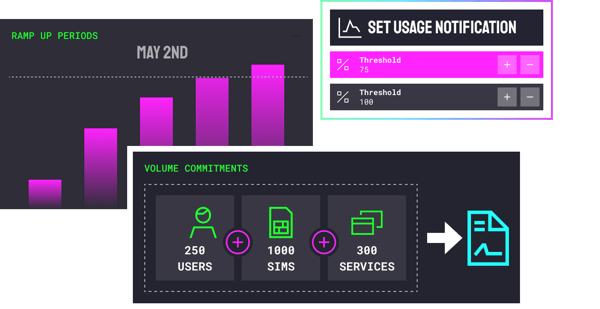
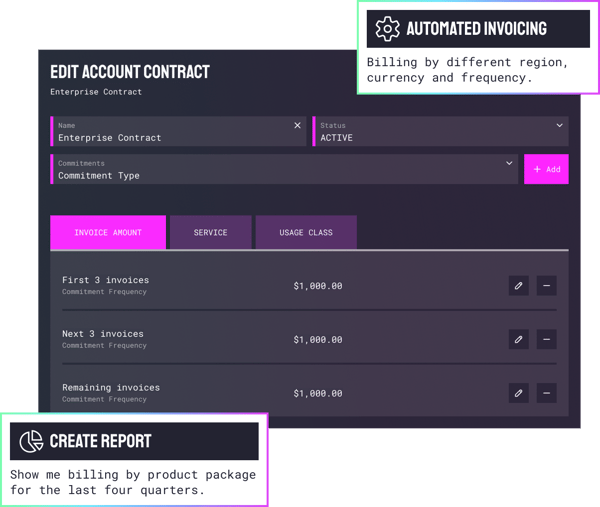
LogiSense is an enterprise billing and monetization platform that supports complex, usage-based, subscription, and hybrid business models. We help organizations capture, rate, and recognize revenue accurately, regardless of pricing model, contract structure, or volume.
Our platform handles the operational weight that legacy systems offload to manual workarounds: mediation of high-volume usage data, enforcement of contract-specific pricing, mid-cycle changes, multi-level account hierarchies, and the downstream reporting that Finance and Audit depend on.
This is not a billing add-on. It is purpose-built monetization infrastructure, designed from the ground up to handle complexity at scale.
Trusted where billing failure is not an option
Our platform is used by organizations that cannot afford billing errors. Customers like Cisco, Vonage, 8x8, and Garmin have chosen LogiSense for environments where pricing is complex, volumes are high, and accuracy is non-negotiable.
They did not choose LogiSense because it was the easiest option. They chose it because it was the right one.
-
Trusted to enforce complex, customer-specific pricing and contract terms
-
Deployed to process large volumes of usage data accurately at scale
-
Used to support evolving pricing strategies without platform re-engineering
-
Relied upon as the long-term billing foundation for mission-critical revenue operations
Built for the industries where billing is never simple
Communications service providers
SaaS and XaaS businesses
IoT and connected service companies
Data and digital service monetizers
What we believe, and how we work
Our mission is to help organizations bring accuracy, control, and confidence to the way they monetize their products and services. We believe no business can grow sustainably when the system it relies on to capture and recognize revenue is unpredictable.
-
Trusted accuracy and trust. Revenue confidence is non-negotiable. Every pricing rule, usage event, and invoice must be traceable and defensible.
-
Long-term partnership. We build relationships, not transactions. Our customers' success over time is the measure of ours.
-
Engineering rigor. Monetization complexity demands discipline and precision. We do not cut corners in the places that matter most.
-
Transparency and accountability. Clear outcomes, clear ownership. Our customers know what they are getting and who is responsible for delivering it.
-
Continuous improvement. Monetization models evolve, and so do we. The platform our customers rely on today will be more capable tomorrow.
The team behind the platform

Chief Executive Officer

Chief Technology Officer

VP of Finance and Treasurer

Corporate VP of Global Services

VP of Sales

VP of Strategic Operations

Sr. Director of Product Management
Trusted by leading companies


Frequently Asked Questions
What should enterprises look for in a usage-based billing platform?
How is LogiSense different from other usage-based billing platforms?
LogiSense is designed for complex, enterprise-scale monetization rather than simple metering or recurring invoicing alone. It brings usage mediation, rating, pricing, contract management, billing, and revenue operations together in one platform.
Organizations can use LogiSense to process high volumes of usage data, enforce negotiated contract terms, support customer-specific pricing, and operate subscription, usage-based, and hybrid models in parallel. This reduces the need to connect multiple point solutions or rely on engineering teams to build and maintain custom billing logic.
LogiSense also provides traceability from the original usage event through rating and invoicing, giving Finance, Product, and IT a consistent view of how usage becomes revenue. Global organizations including Cisco, Vonage, 8x8, Five9, and Garmin have selected LogiSense for complex and mission-critical billing environments.
What types of businesses are the best fit for LogiSense?
LogiSense is best suited to organizations whose pricing and billing requirements have moved beyond straightforward recurring subscriptions.
A strong fit typically includes businesses processing large volumes of usage events, managing complex or customer-specific contracts, combining recurring and variable charges, or operating across multiple products, business units, currencies, or markets. LogiSense is commonly used by communications, SaaS and XaaS, IoT, cloud, digital services, and AI businesses where consumption directly affects revenue.
It is particularly valuable when billing changes require too much engineering support, manual reconciliation is increasing, existing systems cannot enforce contract terms consistently, or launching new pricing models has become slow and risky.
For businesses with only simple, fixed monthly subscriptions and limited pricing variation, a less specialized billing tool may be sufficient.
Can LogiSense replace a legacy or internally built billing system?
Yes. LogiSense can replace legacy billing platforms, internally developed billing engines, spreadsheet-based processes, or disconnected systems that no longer support the organization’s pricing and operational requirements.
The appropriate migration approach depends on the existing architecture, usage sources, data quality, integrations, pricing rules, contract structures, and billing volumes. A transition may involve migrating the entire billing operation or introducing LogiSense in phases for specific products, business units, customer groups, or new monetization models.
During implementation, usage data and pricing logic can be validated before production billing begins. This helps organizations reduce migration risk, preserve billing continuity, and confirm that charges are calculated correctly.
Moving to LogiSense also reduces the long-term burden of maintaining custom billing code whenever products, contracts, pricing strategies, or regulatory requirements change.
How does LogiSense integrate with CRM, ERP, tax, payment, and revenue systems?
LogiSense uses an API-first architecture to connect billing with the systems that support the broader quote-to-cash and revenue lifecycle.
It can receive customer, contract, product, and pricing information from CRM and CPQ systems; ingest usage from applications, networks, devices, and data platforms; and send invoice and financial information to ERP, general ledger, tax, payment, revenue recognition, reporting, and customer-facing systems.
LogiSense provides RESTful APIs, webhooks, workflow automation, sandbox environments, and flexible data models so organizations can integrate the platform into their existing architecture rather than replacing every surrounding system.
This enables LogiSense to operate as the monetization layer that connects product usage and commercial agreements with accurate downstream billing and financial outcomes.
Can LogiSense support subscription, usage-based, and hybrid pricing models?
Yes. LogiSense supports recurring subscriptions, usage-based charges, and hybrid pricing models that combine fixed and variable fees within the same customer agreement.
Organizations can configure tiered, volume-based, graduated, pooled, prepaid, postpaid, commitment-based, overage, minimum-spend, bundled, and customer-specific pricing structures. The platform can also support allowances, credits, promotions, discounts, entitlements, contract ramps, and other conditional pricing rules.
Usage can be rated in real time or in batches, depending on the business requirement. This allows companies to support predictable recurring revenue while also charging customers for measurable consumption such as API calls, transactions, minutes, messages, devices, storage, bandwidth, compute, or AI tokens.
Because these models can operate on a common platform, businesses can evolve their pricing without introducing a separate billing system for every new monetization strategy.
How long does a LogiSense implementation take, and what support is provided?
Implementation timelines vary according to the complexity of the billing environment. Important factors include the number of products and pricing models, usage-data sources, customer and contract migration requirements, required integrations, invoice design, testing procedures, and deployment scope.
A LogiSense implementation typically includes discovery, solution design, platform configuration, integration, data preparation, pricing validation, testing, deployment, and operational enablement. Organizations can also take a phased approach, beginning with a specific product, customer segment, or business unit before expanding the platform more broadly.
LogiSense provides implementation expertise and ongoing support to help customers configure the platform, validate billing outcomes, manage integrations, and adapt the system as their requirements evolve.
A detailed implementation plan should be developed during the evaluation process so responsibilities, dependencies, timelines, and success criteria are understood before the project begins.
How can enterprises justify the investment in a new billing platform?
The business case should consider more than software licensing costs. Enterprises should evaluate the financial and operational impact of revenue leakage, billing errors, manual reconciliation, customer disputes, engineering workarounds, delayed product launches, and the ongoing maintenance of legacy or internally built systems.
A modern billing platform can create value by improving billing accuracy, reducing manual effort, accelerating the introduction of new products and pricing models, and lowering the cost and risk associated with billing complexity.
Organizations should establish measurable baseline indicators such as adjustment volumes, time spent on reconciliation, billing-related support cases, engineering hours, invoice delays, revenue leakage, and the time required to launch pricing changes.
A Forrester Total Economic Impact study commissioned by LogiSense reported $12.9 million in present-value benefits, a $9.52 million net present value, and a 283% return on investment for the organization studied. Actual results will depend on each company’s operating environment and implementation scope.

Inside the Mind of a CEO

Cisco Replaces Zuora With LogiSense

Let's talk
- Find out whether our experience maps to the complexity you're seeing
- Understand how we work with customers
- See how other operators have found working with LogiSense
- Get an honest sense of whether we're the right fit for your business