
Usage-based pricing shifts the focus of go-to-market strategy beyond customer acquisition and contract signing. Because revenue depends on ongoing consumption, businesses must prioritize product adoption, customer engagement, retention, and expansion. Sales, marketing, product, finance, and customer success teams need to coordinate their efforts to ensure customers continuously realize value from the products they use.
podcast
Rethinking GTM for Usage-Based Revenue
How Usage-Based Pricing Is Changing Go-to-Market Strategy
What happens to your go-to-market (GTM) strategy when revenue depends on how customers use your product rather than what they sign up for?
As SaaS and technology companies move toward usage-based and outcome-based pricing, traditional go-to-market strategies must evolve. Closing the deal is no longer the finish line. Sustainable revenue growth increasingly depends on customer adoption, value realization, retention, and expansion.
In this episode of the LogiSense Podcast, Tim Neil is joined by Tim Hillison, Founder of Entry Point 1, to explore how usage-based revenue is reshaping GTM strategies and why pricing must be connected to the entire customer lifecycle.
Drawing on 25 years of go-to-market leadership experience, Tim shares why successful monetization requires alignment across sales, marketing, product, customer success, and finance.
In this episode, you'll discover:
- Why usage-based pricing fundamentally changes traditional GTM strategies
- How to align pricing with measurable customer outcomes and value
- Why revenue growth must extend beyond customer acquisition
- How AI and consumption-based business models are changing forecasting and pricing strategies
- Why pricing transparency and predictability matter for customer retention
- How product usage signals and net revenue retention (NRR) can inform growth strategies
- Why organizational agility is essential for successful usage-based monetization
The key takeaway: Usage-based pricing is more than a billing model. It requires a connected GTM strategy that aligns customer value, product consumption, and revenue growth.
About the guest
Tim Hillison is the Founder of Entry Point 1, where he helps engineering-led startups and mid-market companies build adaptive go-to-market systems. With 25 years of experience, including three CMO roles, he brings a practical perspective on GTM transformation, growth strategy, and customer value.
Continue learning
Usage Economy Summit
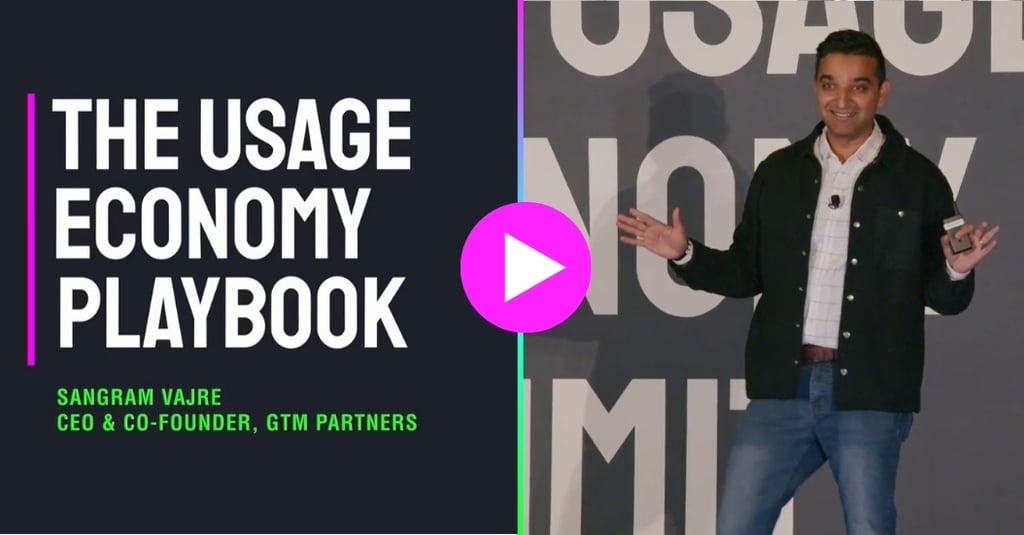
The Usage Economy Playbook
Teams across marketing, sales, and product often define GTM differently, which creates misalignment and stalled execution. Companies must develop a shared, explicit definition of go-to-market that matches their operating model in order to move with focus and consistency.
Speak with an Expert
Ready to Operationalize Your Usage-Based Revenue Strategy?
Speak with a LogiSense expert to discover how flexible usage monetization can help your organization support evolving pricing models, improve revenue visibility, and scale with customer demand.
FAQ
How does usage-based pricing change go-to-market strategy?
What is the difference between usage metrics and value metrics?
Usage metrics measure how customers interact with a product, such as API calls, transactions, compute consumption, or active users. Value metrics measure the benefits customers receive, such as improved productivity, reduced costs, or operational efficiency. While usage metrics can support billing, effective usage-based pricing requires businesses to understand whether those metrics accurately reflect customer value.
Why is net revenue retention important for usage-based SaaS companies?
Net revenue retention (NRR) measures how recurring revenue changes within an existing customer base, accounting for expansion, contraction, and churn. For usage-based SaaS companies, it helps indicate whether customers are increasing or reducing their spending over time. Monitoring NRR alongside product adoption and customer outcomes provides valuable insight into retention, expansion opportunities, and the sustainability of revenue growth.
How can companies maintain revenue predictability with consumption-based pricing?
Consumption-based pricing introduces variability because customer spending changes with usage. Businesses can improve predictability through transparent pricing structures, timely usage reporting, spending alerts, and more accurate consumption forecasting. Connecting these capabilities with customer success and finance processes helps organizations manage expectations, anticipate changes in spending, and reduce unexpected billing surprises.