

API-First Billing: Why It Matters
Modern businesses rarely operate from a single application. CRM platforms, CPQ solutions, ERP systems, payment gateways, tax engines, provisioning platforms, customer portals, AI services, and data warehouses all need to exchange information in real time. When these systems are connected through fragile custom integrations or manual processes, innovation slows, operational costs rise, and revenue opportunities are missed.
An API-first architecture addresses these challenges by making every core business capability accessible through secure, standardized APIs. Instead of treating APIs as an afterthought, organizations design them first, enabling faster development, greater flexibility, and seamless integration across the enterprise.
For organizations managing subscription, usage-based, or hybrid pricing models, an API-first billing platform is no longer optional. It is a critical foundation for growth.
Why API-First Design Matters
Accelerate System Integration
An API-first approach simplifies integration between billing, CRM, ERP, payment processing, taxation, provisioning, and customer-facing applications. Standardized REST APIs reduce development effort, eliminate manual workflows, and ensure data flows consistently across your technology ecosystem.
Scale Without Rebuilding
As your business introduces new products, pricing models, markets, or digital services, your billing platform should adapt without requiring extensive redevelopment. API-first architectures provide the flexibility to expand existing capabilities while maintaining system stability.
Improve Developer Productivity
Clearly documented APIs allow development teams to build integrations, automate workflows, and develop new applications independently. Front-end and back-end teams can work in parallel, reducing implementation timelines and accelerating product delivery.
Enable Automation
APIs allow organizations to automate customer onboarding, product creation, subscription management, usage ingestion, invoicing, payments, and reporting. This reduces manual effort while improving operational efficiency and accuracy.
Support AI-Driven Applications
As organizations increasingly adopt AI-powered services and intelligent automation, APIs become the primary mechanism for exchanging data between systems. API-first platforms enable AI applications to provision services, retrieve usage data, trigger billing events, and automate operational processes without manual intervention.
Future-Proof Your Technology Stack
Technology evolves rapidly. Whether integrating new payment providers, CPQ solutions, AI services, or customer portals, an API-first platform provides the flexibility to adopt new technologies without replacing your billing infrastructure.
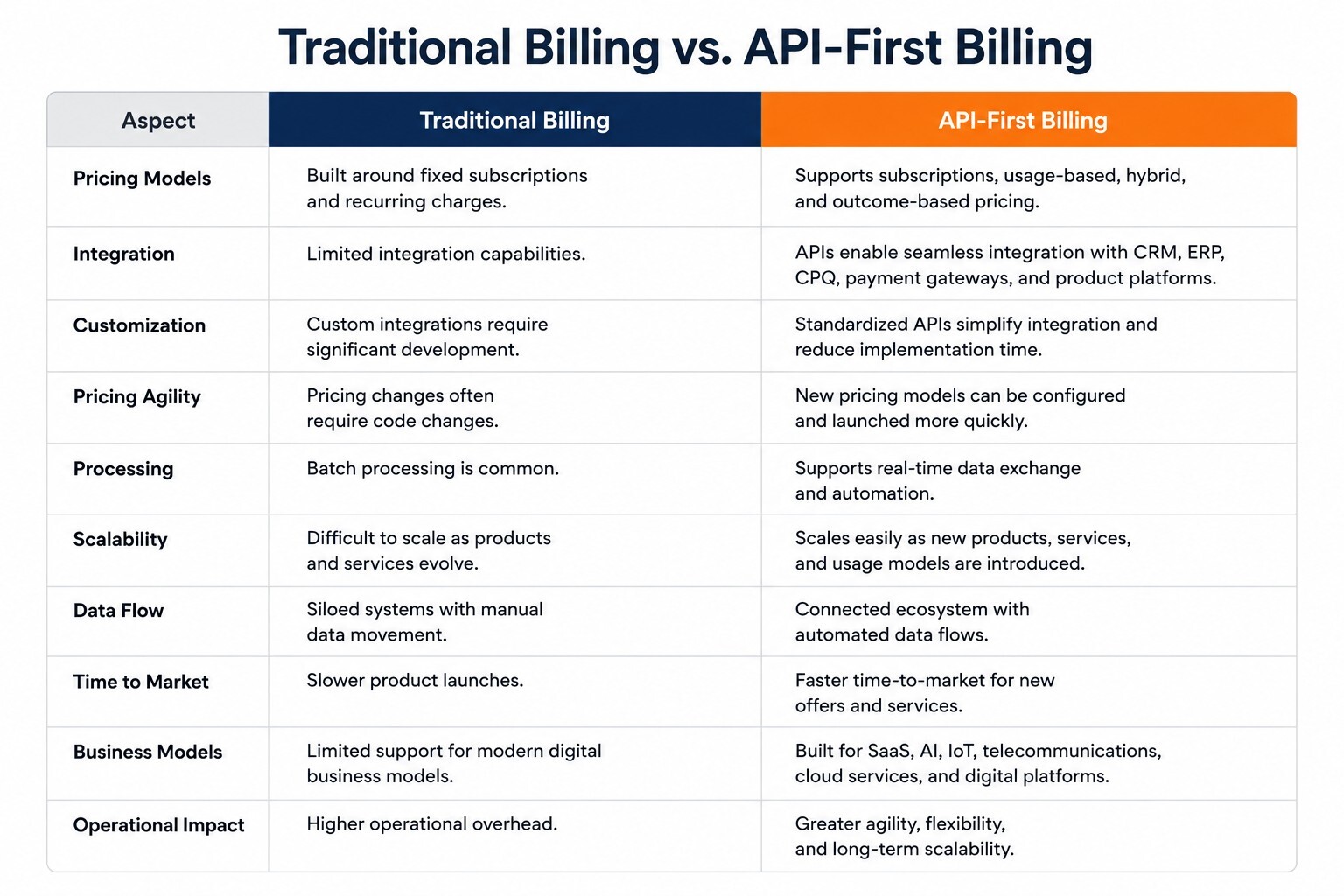
Traditional Billing vs. API-First Billing
How LogiSense Enables API-First Billing
LogiSense was designed with an API-first philosophy, enabling organizations to integrate billing into virtually any business ecosystem while supporting modern monetization strategies.
Comprehensive REST APIs
The LogiSense Developer Portal provides extensive REST APIs covering the core billing lifecycle, including:
- Customer and account management
- Product catalog management
- Sales orders
- Usage submission
- Invoice generation
- Payments
- Bill runs
- Credit notes
Developers can quickly integrate these capabilities into internal systems, customer applications, or partner platforms.
Interactive Developer Experience
The LogiSense Developer Portal includes comprehensive documentation, authentication guidance, request examples, and interactive API testing capabilities. Developers can authenticate, explore endpoints, and validate integrations directly within the portal, significantly reducing implementation time.
Built for Enterprise Integration
LogiSense integrates seamlessly with CRM, ERP, CPQ, payment gateways, tax engines, customer portals, and provisioning systems. This enables organizations to automate revenue operations across their entire technology stack while maintaining data consistency.
Scalable Architecture
Whether you're monetizing connected devices, telecommunications services, SaaS applications, AI platforms, APIs, or digital services, LogiSense provides the scalability required to support millions of transactions and evolving pricing models.
Operational Visibility
Beyond exposing APIs, LogiSense provides logging, monitoring, and analytics that help development teams diagnose issues, monitor API activity, and optimize integration performance.
Common API-First Use Cases
Organizations use LogiSense APIs to:
- Automate customer onboarding
- Synchronize CRM and ERP systems
- Create and update products programmatically
- Import high-volume usage data
- Trigger automated billing runs
- Retrieve invoices for customer portals
- Process payments
- Build self-service applications
- Integrate AI-driven operational workflows
Build a Connected Monetization Platform
An API-first architecture is no longer simply a software development best practice. It is the foundation for modern monetization.
By exposing billing functionality through secure, well-documented REST APIs, organizations can automate revenue operations, simplify integrations, accelerate product launches, and support evolving pricing strategies without introducing unnecessary complexity.
Whether you're integrating Salesforce, Microsoft Dynamics, NetSuite, payment gateways, customer portals, AI applications, or proprietary business systems, LogiSense provides the APIs and developer tools needed to build a connected monetization ecosystem.

Continue learning

API Reference
Future-Proof Your Tech Stack
LogiSense Blog
Latest articles
Selecting a real-time usage rating platform requires more than comparing feature lists.
Product teams are under constant pressure to ship faster, add new capabilities, respond to customer demand, and increasingly, embed AI into their...
Every discussion about AI eventually arrives at the same question:
Usage-based pricing is giving SaaS companies more flexibility in how they package and sell their products. Instead of charging every customer the...
For years, network growth was relatively predictable.