

How to Evaluate a Real-Time Usage Rating Platform
Selecting a real-time usage rating platform requires more than comparing feature lists.
Enterprise SaaS businesses often need to manage negotiated contracts, tiered pricing, commitments, prepaid balances, shared usage, hybrid subscription models, and frequent pricing changes. A platform may perform well in a simple demonstration but struggle when exposed to real commercial complexity.
Finance and billing leaders should therefore evaluate a platform based on how well it supports actual pricing models, protects invoice accuracy, exposes revenue risk, and reduces operational dependence on engineering.
The following framework can help teams compare real-time usage rating platforms more effectively.
Start with Your Most Difficult Customer Agreements
Do not begin with the vendor’s standard demonstration.
Before evaluating a platform, identify the commercial scenarios that are hardest to manage today or most important to future growth.
Examples may include:
- Fixed subscription fees combined with usage charges
- Included usage with tiered overages
- Annual commitments consumed monthly
- Prepaid credits or drawdowns
- Shared usage across departments or subsidiaries
- Customer-specific rates
- Multiple currencies
- Mid-period contract amendments
- Product-, region-, or attribute-based pricing
- Parent-child account hierarchies
These scenarios should become the basis of the evaluation.
A platform should be tested against the pricing your sales team actually negotiates, not only against a flat per-unit example prepared by the vendor.
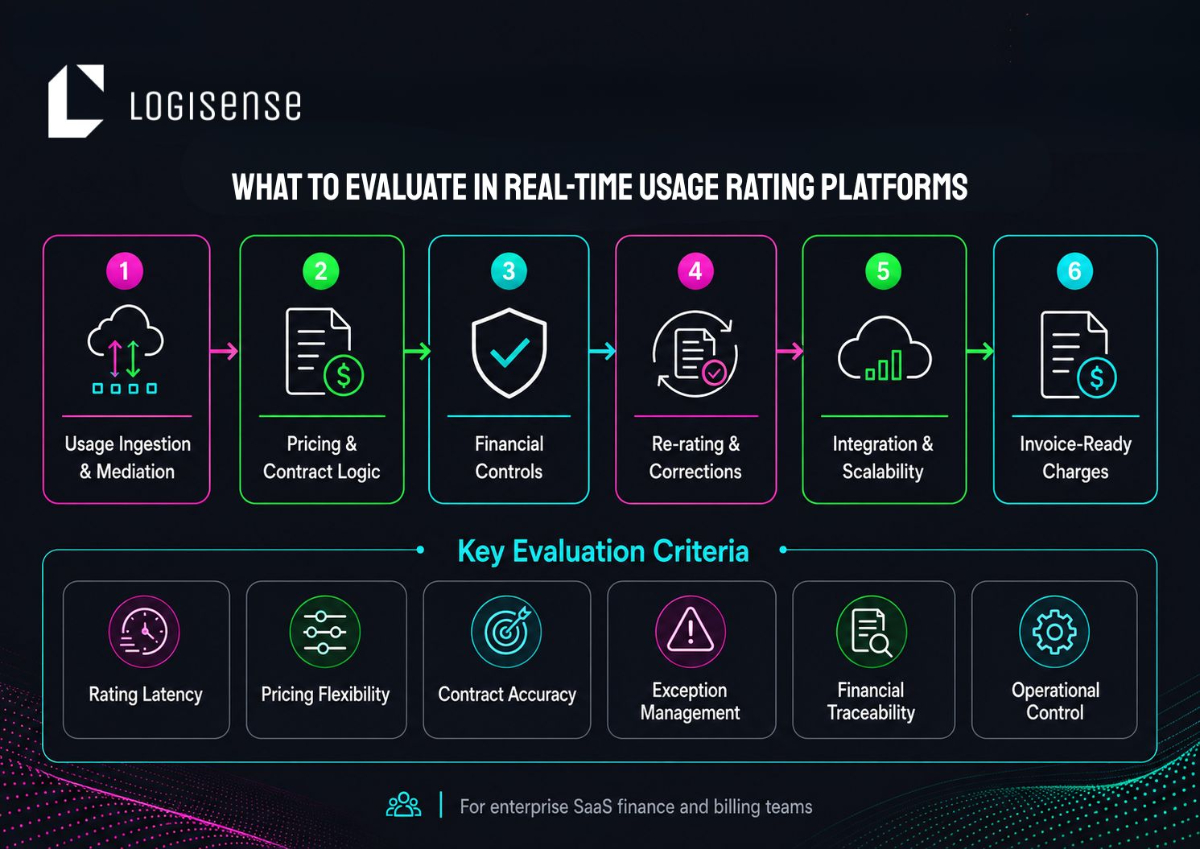
1. Define the Required Rating Latency
Vendors often use “real time” to describe different capabilities.
Some platforms receive usage immediately but apply pricing later. Others provide quick dashboard updates while the authoritative charge is still calculated during a scheduled process.
Ask the vendor to define the complete path from event receipt to financially rated charge.
Key questions include:
- How quickly is usage validated?
- When is pricing applied?
- When can finance see the charge?
- Is the amount authoritative or estimated?
- Does latency change when complex rules are applied?
- How are processing backlogs recovered?
- Are performance commitments documented?
The required latency should reflect the needs of the business.
A company managing prepaid balances or customer spending thresholds may need charges calculated within seconds. Another may only need usage rated frequently enough to identify exceptions before the invoice run.
The goal is not to select the fastest platform available. It is to choose one that can meet the required service level under realistic operating conditions.
2. Evaluate Usage Ingestion and Mediation
Usage data may arrive from multiple applications, cloud environments, partner systems, or product lines. Those records may use different formats, identifiers, timestamps, and units.
The platform must be able to prepare that data for reliable financial processing.
Evaluate whether it can:
- Receive both streaming and batch usage
- Support APIs, files, and event-based integrations
- Normalize different data formats
- Convert units of measure
- Enrich records with customer or product information
- Identify duplicate events
- Process late or out-of-order records
- Quarantine invalid usage
- Correct and replay failed events
Exception handling is particularly important.
Ask the vendor to demonstrate what happens when a record is missing an account identifier, refers to an invalid product, or cannot be matched to active pricing.
Finance and billing teams should be able to see why the event failed, correct the underlying issue, and replay the record without relying on a database administrator or custom script.
3. Test Pricing and Contract Complexity Together
The rating engine should not be evaluated one capability at a time.
A platform may support tiers, commitments, discounts, and credits individually but fail when several rules must be applied together.
Create a representative scenario that combines multiple commercial conditions.
For example:
A customer pays a fixed monthly subscription that includes a usage allowance. Consumption is shared across three subsidiaries. Overage is calculated using graduated tiers, and one product receives a negotiated discount.
Ask the vendor to configure and process this scenario.
The evaluation should test capabilities such as:
- Flat, tiered, graduated, and volume pricing
- Included usage and overages
- Minimum commitments
- Prepaid and postpaid models
- Credit balances and drawdowns
- Shared usage pools
- Customer-specific discounts
- Multi-attribute pricing
- Multiple currencies
- Hybrid subscription and usage models
Also test how the platform manages effective dates.
When a contract changes during the billing period, usage before and after the amendment may require different rates. The platform should preserve historical pricing and apply the correct terms based on when the usage occurred.
If complex pricing depends on extensive custom development or vendor services, that dependency should be included in the total cost and operating-model assessment.
4. Assess Financial Controls and Traceability
The platform should provide more than a calculated charge. It should provide evidence explaining how that charge was created.
A billing analyst should be able to trace an invoice amount back through:
- The rated charge
- The source usage
- The customer and product assignment
- The applicable contract
- The pricing rule
- Any transformation or adjustment
Evaluate whether the platform provides:
- Usage validation
- Duplicate controls
- Effective-date validation
- Exception workflows
- Pre-invoice review
- Reconciliation reporting
- Approval controls
- Adjustment governance
- Configuration history
- Audit trails
Also determine whether finance can identify usage that has not successfully become billable revenue.
Useful operational reporting should expose:
- Rejected events
- Unrated usage
- Accounts without valid pricing
- Records awaiting enrichment
- Processing backlogs
- Differences between received and rated usage
- Differences between rated and invoiced charges
A platform that reports only successfully processed usage may hide the records that create the greatest financial risk.
5. Test Corrections and Re-Rating
Usage and contract data are not always correct when first processed.
Records may arrive late, customer mappings may change, pricing may be approved retroactively, or an amendment may be received after usage has already been rated.
Ask the vendor to demonstrate how the platform handles:
- Late-arriving usage
- Duplicate submissions
- Corrected source events
- Previously rejected records
- Retroactive price changes
- Contract amendments
- Historical re-rating
- Post-invoice adjustments
- Credits and rebills
The original record should remain available, and every correction should be auditable.
Finance should be able to see what changed, who approved it, which charges were affected, and whether an invoice adjustment was required.
Be cautious if re-rating depends on destructive edits, direct database changes, or manual reconstruction of the billing period.
6. Review Scalability, Integration, and Usability
Scalability should be assessed using both event volume and pricing complexity.
Ask the vendor to test:
- Normal and peak event volumes
- Backlog recovery after an outage
- Large account hierarchies
- Numerous customer-specific prices
- Shared balances
- Multi-dimensional rating
- Historical re-rating
A platform that processes millions of simple events may perform very differently when each event must be evaluated against complex contracts and accumulating balances.
The platform must also fit the wider revenue architecture.
Review integration with:
- CRM
- CPQ
- Product catalog
- Contract management
- ERP and general ledger
- Tax systems
- Revenue recognition platforms
- Data warehouses
- Customer portals
Clarify which system remains authoritative for customers, pricing, contracts, usage, rated charges, and invoices.
Finally, determine how much control finance and billing teams will have.
Authorized business users should be able to manage routine activities such as rate plans, commitments, effective dates, credits, exceptions, and re-rating without creating uncontrolled financial risk.
Look for role-based access, approval workflows, sandbox environments, version history, testing controls, and rollback options.
7. Run a Realistic Proof of Concept
A product demonstration shows what the vendor wants to present. A proof of concept shows whether the platform can support your business.
Provide representative:
- Usage data
- Customer contracts
- Pricing rules
- Account hierarchies
- Exceptions
- Contract amendments
- Peak-volume assumptions
Ask the vendor to demonstrate the full process:
- Receive the usage
- Validate and transform it
- Match it to the correct customer and contract
- Apply the pricing rules
- Handle an exception
- Correct and replay the event
- Produce a rated charge
- Reconcile it to the invoice
- Display the audit history
This is more valuable than reviewing a long checklist of capabilities that may never be tested together.
Warning Signs to Watch For
Potential warning signs include:
- “Real time” is not supported by measurable latency
- Demonstrations rely only on flat per-unit pricing
- Usage preparation requires extensive custom code
- Failed records are difficult to find or replay
- Historical prices are not preserved
- Charges cannot be traced to source usage
- Re-rating requires destructive changes
- Finance cannot manage routine configuration
- Scalability claims exclude complex pricing scenarios
- Core capabilities depend heavily on professional services
A limitation does not automatically disqualify a platform, but its operational and financial impact should be understood before selection.
Use a Weighted Evaluation Scorecard
A scorecard can help finance, billing, product, and technology teams compare vendors consistently.
Recommended categories include:
- Usage processing: ingestion, mediation, exception handling, and replay
- Pricing flexibility: tiers, commitments, credits, hybrid pricing, and contract-specific rates
- Financial controls: traceability, reconciliation, auditability, and leakage visibility
- Performance: latency, scale, backlog recovery, and complex-rule processing
- Integration: APIs, ERP, CRM, CPQ, tax, and financial systems
- Operational usability: finance configuration, permissions, approvals, and testing
Weight each category according to the business model.
A high-volume API company may prioritize throughput and latency. A SaaS provider with heavily negotiated enterprise contracts may place greater weight on effective dating, customer-specific pricing, and auditability.
Select for Revenue Confidence
The strongest real-time usage rating platform is not necessarily the one with the longest feature list.
It is the one that can apply your commercial agreements accurately, process usage reliably, expose exceptions clearly, and provide a complete audit trail from source event to invoice.
The evaluation should ultimately answer one question:
Can this platform support the pricing models we sell while giving finance confidence that usage revenue is complete, accurate, and explainable?
That answer should be demonstrated using your own data, contracts, and operating conditions.

Continue learning

Building the Bottom Line with Usage Rating

Evaluate Your Usage Rating Architecture with LogiSense
Speak with a LogiSense expert to evaluate whether your current usage rating architecture can support your next generation of recurring revenue models.
LogiSense Blog
Latest articles
Product teams are under constant pressure to ship faster, add new capabilities, respond to customer demand, and increasingly, embed AI into their...
Every discussion about AI eventually arrives at the same question:
Usage-based pricing is giving SaaS companies more flexibility in how they package and sell their products. Instead of charging every customer the...
For years, network growth was relatively predictable.
Telecom operators are entering an environment where networks are no longer managed primarily through static policies and manual operational oversight.