

AI Agent Monetization: Commercial Accountability at Scale
AI agents are beginning to operate less like individual software tools and more like coordinated teams.
One agent retrieves information. Another evaluates the available options. A third executes an action, while a fourth verifies the result.
From the customer's perspective, the experience may be straightforward. A request is submitted, and a task is completed.
Behind that interaction, however, multiple autonomous systems may have consumed resources, accessed services, and triggered financial events.
This introduces a question that deserves greater attention as enterprises deploy increasingly sophisticated AI systems:
When multiple AI agents contribute to a transaction, how does a business determine who is commercially responsible for what happened?
The answer requires more than technical monitoring. It requires a reliable connection between agent activity, customer entitlements, contractual obligations, and the financial records used to support billing.
Multi-Agent Systems Introduce a New Accountability Challenge
The AI Summit's Future of AI: Top Trends for 2026 report identifies agentic and multi-agent systems as a significant development in enterprise AI.
Its first trend describes the movement from individual AI assistants toward coordinated systems operating with defined policies, human oversight, and continuous monitoring.
Enterprise technology providers are already developing the infrastructure to support these environments.
For example, Amazon Bedrock's multi-agent architecture illustrates how supervisory agents can coordinate specialized agents to complete complex tasks.
These developments are important for enterprise automation. But coordinating activities across multiple agents creates commercial questions that traditional application monitoring was not designed to answer.
Consider a software provider offering an AI-powered procurement service.
A customer asks the system to identify suitable suppliers, compare pricing, and prepare a purchase recommendation.
The request initiates several activities:
- A research agent retrieves supplier information.
- An analysis agent compares commercial terms.
- A validation agent checks supplier eligibility.
- A document agent prepares the recommendation.
- An orchestration agent manages the overall workflow.
Each component contributes to the result, but not every action represents a separate customer charge.
Some activities may be included in the customer's subscription. Others may consume prepaid allowances or qualify as premium services.
If the workflow fails and must be repeated, should the customer pay for the additional processing?
If a third-party agent performs part of the work, which provider is responsible for the associated charge?
These are not simply questions about how much AI costs to operate. They concern how commercial obligations are assigned and enforced across an increasingly distributed service.
Technical Observability Is Not the Same as Financial Traceability
Modern observability tools can capture extensive information about agent execution.
In July 2026, AWS announced unified observability for Amazon Bedrock AgentCore, bringing agent traces, prompts, and logs together to simplify operational monitoring.
This type of visibility helps engineering teams investigate failures, understand system behavior, and optimize performance.
However, a technical execution record does not automatically establish whether an action should generate a customer charge.
A log might confirm that an agent made five API calls. It does not necessarily identify whether those calls were included in the customer's agreement, should count toward a usage allowance, or represent duplicate processing.
Technical observability explains what an agent did. Financial traceability establishes how that activity affects the commercial relationship.
Bridging the two requires organizations to distinguish between operational events and commercially meaningful events.
A model invocation may be relevant to internal cost accounting without being directly billable. A successfully completed workflow may represent a single chargeable transaction even when dozens of underlying operations contributed to its completion.
That distinction becomes especially important when organizations introduce multi-agent services with negotiated enterprise contracts.
Four Questions Every Multi-Agent Commercial Architecture Must Answer
As AI agents participate in customer-facing transactions, organizations need a consistent way to connect autonomous activity with commercial policy.
1. Which customer authorized the activity?
In a multi-agent workflow, an individual agent may act on behalf of another agent rather than receiving instructions directly from a customer.
The system therefore needs a reliable way to preserve the relationship between the originating customer, the authorized workflow, and the agents carrying out its execution.
Agent identity alone is insufficient.
Organizations must also understand the customer account, service entitlement, and delegated authority associated with an action.
Without that context, accurately attributing downstream consumption becomes difficult.
2. Did the activity satisfy the conditions for billing?
Not every completed action should automatically become a billable event.
A workflow might include retries, validation steps, internal calculations, or actions performed as part of service recovery.
The commercial system needs rules that distinguish chargeable activity from operational overhead.
For example, a contract might permit charging only when a report is successfully delivered and accepted, regardless of how many internal operations were required.
In another arrangement, consumption may be chargeable regardless of whether the broader workflow succeeds.
The correct treatment depends on the agreed commercial terms.
This makes event classification, service-state validation, and contract-aware rating particularly important.
3. What happens when an agent reaches a commercial boundary?
Autonomous systems may continue executing tasks without requiring approval at every step.
Yet commercial agreements can impose restrictions on what customers are entitled to consume.
An agent might attempt to invoke a premium service, exceed an allocated balance, or initiate an action outside its permitted service tier.
Organizations need mechanisms to evaluate relevant entitlements before an action creates an unauthorized financial commitment.
Depending on the agreement, the appropriate response might involve rejecting the request, seeking additional authorization, or applying a different commercial rule.
This requires coordination between agent orchestration, authorization, entitlement management, and monetization systems.
Importantly, billing software alone does not determine whether an agent has permission to access sensitive information or perform a high-risk action. Those controls remain responsibilities of the broader security and governance architecture.
4. Can the business explain the resulting charge?
Customers purchasing AI-powered services will still expect accurate and understandable billing.
When an invoice includes charges generated through autonomous workflows, finance teams may need to explain which service was consumed, which customer agreement applied, and how the amount was calculated.
That explanation becomes more difficult if relevant records are fragmented across agent frameworks, cloud providers, application databases, and billing systems.
A defensible billing process requires sufficient records to reconstruct the financial treatment of a transaction without exposing unnecessary internal reasoning or sensitive data.
The goal is not to reproduce every technical operation on an invoice.
It is to maintain a trustworthy relationship between the delivered service and the resulting financial record.
Designing a Commercial Event Model for AI Agents
One practical approach is to establish a commercial event model that operates alongside the technical execution architecture.
Rather than sending every model invocation directly to billing, organizations can translate relevant activity into standardized events that carry the information needed for commercial processing.
A conceptual event record might contain:
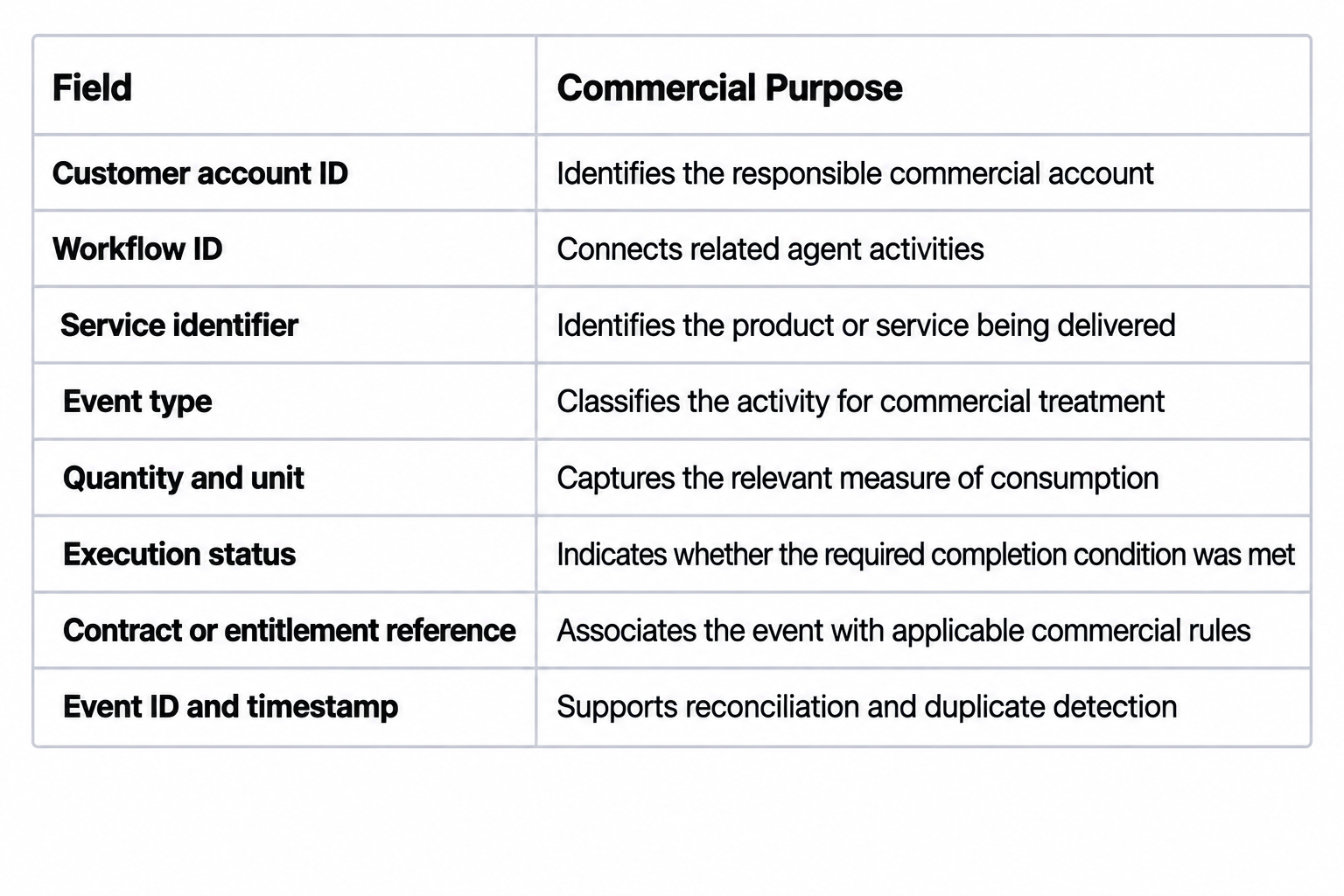
These fields represent an illustrative design, not a universal industry standard.
The event model creates a separation between the internal mechanics of agent execution and the commercial representation of the service.
For example, an AI workflow may generate 40 technical events, but only one customer-billable event if the contract charges per successfully completed workflow.
Another customer may have an agreement requiring separate charges for premium data retrieval and document processing.
A consistent event model allows those differences to be managed through commercial rules rather than requiring each AI agent to implement its own billing logic.
It also creates opportunities to manage reversals, corrections, and disputed usage systematically.
Why Commercial Accountability Matters Beyond Billing
Establishing financial traceability across AI agents has implications for several enterprise functions.
For Product teams, it creates clearer boundaries between included functionality, premium capabilities, and customer entitlements.
For Finance, it supports reconciliation between services delivered, contractual terms, and recorded revenue.
For Engineering, it reduces the need to embed customer-specific commercial rules directly into agent workflows.
For customers, it supports more predictable commercial relationships and a clearer understanding of the services they have purchased.
There is also a governance dimension.
The NIST AI Risk Management Framework emphasizes the importance of managing AI risks throughout the system lifecycle. Commercial traceability is not itself a regulatory certification or a substitute for AI governance, but reliable records can support accountability and investigation when autonomous activity produces unexpected financial outcomes.
As agent ecosystems become more interconnected, these concerns will extend beyond individual applications to workflows involving multiple vendors and service providers.
Where LogiSense Fits
LogiSense helps enterprises manage complex usage-based and hybrid monetization models, including the mediation, rating, billing, and enforcement of customer-specific commercial terms.
These capabilities are relevant to organizations introducing AI-powered services where consumption must be translated into accurate, contract-aware charges.
In a multi-agent environment, organizations can design integrations that pass commercially meaningful usage events from their AI applications and orchestration systems into the monetization process.
The objective is to keep agent execution separate from pricing and billing decisions while maintaining the data relationships required to connect them.
This separation can help organizations evolve their AI applications without having to redesign commercial logic every time they introduce a new agent, model, or workflow.
AI orchestration platforms remain responsible for coordinating agent activity. Identity and security systems manage authentication and authorization. Observability platforms monitor technical execution.
Monetization systems address a different responsibility: applying the appropriate commercial treatment to services consumed or delivered.
When these systems work together, enterprises can support increasingly autonomous services without sacrificing financial accountability.
The Next Challenge Is Commercial Accountability at Scale
Agentic AI is changing how enterprise software performs work.
As organizations adopt multi-agent architectures, the number of autonomous decisions, service interactions, and commercial events can increase substantially.
The challenge is no longer limited to understanding what an individual agent costs or how a particular AI capability should be priced.
It is also about ensuring that autonomous activity remains connected to the customer agreements, entitlements, and financial responsibilities that govern it.
An AI agent may be authorized to complete a task. That does not automatically mean every action it performs is authorized to generate a charge.
Making that distinction consistently will become an important architectural requirement for businesses commercializing autonomous AI services.
The future of agentic AI will depend not only on how effectively agents collaborate, but also on whether enterprises can maintain commercial accountability as those agents operate at scale.

Continue learning

Pricing AI: Finding the Right Metric for Value
Launching AI agents?
LogiSense Blog
Latest articles
For years, telecom charging has been built around relatively familiar dimensions: subscribers, capacity, data volume, recurring fees and service...
Artificial intelligence is transforming how software companies price their products, measure consumption and generate revenue. As businesses move...
Telecom pricing has traditionally been designed around relatively durable commercial constructs: monthly plans, fixed bundles, recurring...
5G Standalone is giving communications service providers more flexibility in how network services are created, configured and delivered. The...
AI is creating a pricing problem for software companies.