
Start by assessing whether the system can capture granular AI usage, apply pricing rules accurately, process usage at the required frequency, and connect consumption to customer contracts and invoices. Warning signs include manual usage reconciliation, delayed rating, limited cost visibility, frequent billing adjustments, and difficulty introducing new pricing models without extensive development work.

AI Is Stress-Testing Modern Quote-to-Cash Systems
Artificial intelligence is rapidly changing how software is built, delivered, consumed, and monetized. But while much of the industry conversation has focused on AI capabilities, copilots, and productivity gains, a far less discussed issue is beginning to emerge behind the scenes:
AI is stress-testing modern quote-to-cash systems.
A recent webinar from MGI Research highlighted an increasingly important reality facing SaaS providers, telecom operators, cloud platforms, and AI-driven businesses: many monetization systems were designed for predictable subscription economics, not dynamic AI-driven consumption models.
And that difference matters more than many organizations realize.
Traditional SaaS Economics Were Predictable
For years, software companies largely operated within a relatively stable commercial framework:
- Per-user subscriptions
- Fixed monthly recurring revenue
- Predictable infrastructure consumption
- Linear pricing models
- Standardized contracts
Traditional quote-to-cash systems evolved around those assumptions.
The operational model was relatively straightforward:
quote the product, provision the user, generate the invoice, recognize the revenue.
But AI changes the economics completely.
AI Introduces Variable Consumption at Scale
AI workloads are fundamentally different from traditional SaaS usage patterns.
Infrastructure costs fluctuate based on:
- Model inference
- Token consumption
- GPU utilization
- Agent activity
- API requests
- Workflow complexity
- Autonomous task execution
In many cases, the cost to serve one customer can vary dramatically from another, even within the same pricing tier.
That creates a new challenge for finance, operations, and product leaders:
How do you monetize AI profitably while maintaining operational control?
This is where traditional quote-to-cash systems begin to show strain.
The Rise of the “AI Margin” Problem
One of the more important themes emerging in the AI monetization conversation is margin visibility.
Historically, SaaS margins were relatively easy to model. Companies could forecast infrastructure costs and revenue growth with reasonable confidence.
AI introduces much greater unpredictability.
A customer generating heavy AI workloads may consume significantly more infrastructure resources than anticipated. Another may use advanced AI functionality far less than expected. Meanwhile, infrastructure pricing itself continues to evolve rapidly.
As a result, organizations are beginning to ask more operational questions:
- Which AI services are actually profitable?
- Which customers generate disproportionate infrastructure costs?
- How should AI usage be rated and billed?
- How should hybrid pricing models be structured?
- How do we explain variable AI charges clearly to customers?
- How do we forecast AI revenue accurately?
These are no longer just pricing questions.
They are quote-to-cash questions.
Why Legacy Monetization Systems Struggle
Many monetization systems were originally built around static subscriptions and standardized recurring billing models.
AI monetization introduces a level of operational complexity those systems were never designed to handle.
Organizations are increasingly encountering challenges such as:
- Limited usage visibility
- Rigid pricing structures
- Disconnected mediation and billing systems
- Difficulty handling hybrid contracts
- Delayed rating processes
- Poor invoice transparency
- Revenue leakage risks
- Inconsistent reporting between product, finance, and operations teams
Even companies experimenting aggressively with AI products often underestimate the operational infrastructure required to monetize those products effectively at scale.
Launching AI capabilities is one challenge.
Monetizing them sustainably is another entirely.
Hybrid Monetization Models Are Becoming the New Reality
As AI adoption accelerates, many organizations are discovering that traditional “one-size-fits-all” pricing approaches no longer work.
Instead, businesses are moving toward hybrid monetization models that combine:
- Subscription pricing
- Usage-based pricing
- Consumption drawdowns
- Overage models
- Entitlements
- Tiered usage structures
- Outcome-based pricing
- Prepaid and postpaid combinations
This creates significantly greater complexity across the quote-to-cash lifecycle.
Pricing logic becomes more dynamic.
Contracts become more customized.
Usage data becomes more granular.
Billing becomes more variable.
Revenue recognition becomes more complicated.
The operational demands increase rapidly.
AI Is Elevating Monetization Infrastructure Into a Strategic Priority
The companies that succeed in the AI era will not simply be the ones that innovate faster.
They will be the ones capable of monetizing innovation efficiently, transparently, and profitably.
That requires infrastructure capable of:
- Collecting and processing granular usage data
- Supporting dynamic pricing models
- Managing hybrid monetization strategies
- Delivering finance-grade accuracy
- Reducing revenue leakage
- Providing operational visibility into AI margins
- Scaling monetization alongside AI adoption
In other words, the AI era is elevating monetization infrastructure from a back-office billing function into a strategic business capability.
The Future of Quote-to-Cash Is Becoming Consumption-Aware
AI is accelerating a broader shift that has already been underway across SaaS, telecom, cloud, and digital services markets.
Businesses are moving beyond static subscriptions toward more dynamic, consumption-aware commercial models.
That transition affects every stage of the quote-to-cash lifecycle:
- Pricing
- Quoting
- Usage mediation
- Rating
- Billing
- Revenue recognition
- Reporting
- Customer transparency
The organizations that modernize these systems early will likely have a significant operational advantage as AI-driven business models mature.
Because ultimately, AI is not simply changing software products.
It is changing the operational and financial systems required to monetize them.
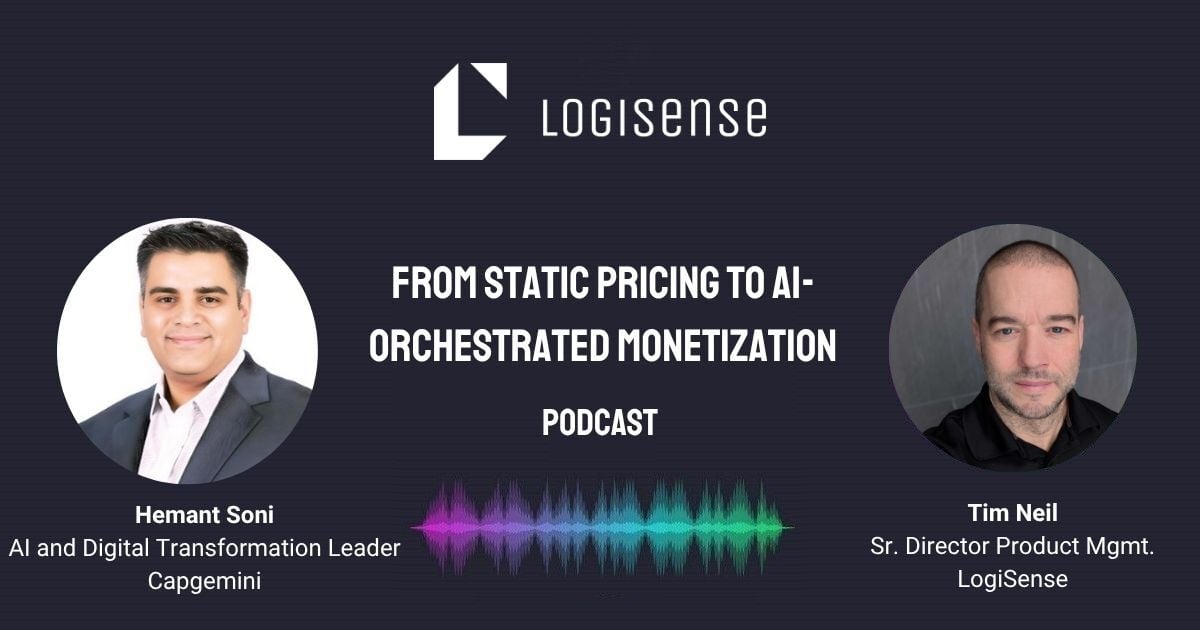
From Static Pricing to AI Orchestrated Monetization
Discover how AI is transforming pricing, bundling, and customer experiences into real-time, dynamic revenue engines.
In this episode, Hemant Soni explains why static pricing can no longer keep up and what is replacing it.
Frequently Asked Questions
How can a company determine whether its quote-to-cash system is ready for AI monetization?
Can an existing subscription billing platform support AI usage-based pricing?
Some subscription billing platforms can support basic usage charges, but AI monetization often requires more than adding an overage line to an invoice. Businesses may also need to process large volumes of usage data, support multiple units of measurement, manage prepaid balances or credits, apply customer-specific pricing, and rate usage before it reaches the billing system. The key question is whether the existing platform can support this complexity reliably at scale.
Does supporting AI monetization require replacing the entire quote-to-cash stack?
Not necessarily. Many organizations can preserve their CRM, CPQ, ERP, payment, and financial systems while adding specialized usage mediation, rating, and monetization capabilities. A modular approach can address gaps in the current architecture without requiring a disruptive replacement of every quote-to-cash component.
Which teams should be involved in evaluating AI monetization infrastructure?
The evaluation should involve Product, Finance, Billing Operations, IT, Revenue Operations, and Sales Operations. Product defines how AI services are packaged, Finance establishes margin and reporting requirements, and technical teams determine how usage will be collected and processed. Cross-functional involvement helps ensure that pricing strategies can be operationalized accurately from contract through invoice.
What should companies prioritize when modernizing quote-to-cash for AI?
Priorities should include accurate usage collection, flexible rating, support for hybrid contracts, transparent customer billing, configurable pricing rules, and visibility into revenue and cost-to-serve. Companies should also consider how quickly the infrastructure can accommodate new AI services, pricing experiments, and customer-specific agreements without creating manual operational work.

Ali Naqvi is a Product Marketing Manager at LogiSense, where he focuses on monetization strategy, usage-based business models, and the evolving economics of SaaS, telecom, and AI-driven services. With over a decade of experience in B2B marketing and demand generation, Ali writes about the intersection of pricing innovation, quote-to-cash transformation, and monetization infrastructure. His work explores how organizations can adapt their commercial operations to support hybrid pricing models, AI consumption, and the growing complexity of modern digital services.
Continue learning

Analyst Report
Monetization Strategies for the AI Economy
Discover how technology leaders are adapting pricing, packaging, and monetization strategies to capture value from AI-driven products and services.
Contact us
Can Your Monetization Stack Support AI?
AI introduces new consumption patterns, pricing models, and billing complexity. Schedule a discussion to evaluate whether your current quote-to-cash architecture can support what's coming next.
LogiSense Blog
The LogiSense blog explores advanced billing solutions, focusing on usage-based pricing, monetization strategies, revenue assurance, and SaaS innovations to help businesses optimize billing processes and adapt to the evolving usage economy.
Latest articles
How to Evaluate a Real-Time Usage Rating Platform
Selecting a real-time usage rating platform requires more than comparing feature lists.
Pricing Should Not Be the Last Step in Product Development
Product teams are under constant pressure to ship faster, add new capabilities, respond to customer demand, and increasingly, embed AI into their...
AI Monetization Starts Where Pricing Strategy Ends
Every discussion about AI eventually arrives at the same question:
Real-Time Usage Rating: A Guide for SaaS Finance Teams
Usage-based pricing is giving SaaS companies more flexibility in how they package and sell their products. Instead of charging every customer the...
AI Agents Are Rewriting Network Economics
For years, network growth was relatively predictable.