
Will Telco’s Continue to Remain Significant Players in the Future of the IoT?
The Internet of Things (IoT) has evolved from an emerging technology into a critical driver of digital transformation. As billions of connected devices generate continuous streams of data, communications service providers (CSPs) have an opportunity to move beyond simply delivering connectivity and become strategic partners in the connected economy.
However, this opportunity also introduces new challenges. Traditional telecom business models and legacy billing platforms were designed for predictable subscription services, not billions of low-value, high-volume usage events. To compete in the IoT era, service providers need modern monetization platforms capable of supporting flexible pricing, real-time usage processing, and rapid service innovation.
The Opportunity Beyond Connectivity
As IoT adoption accelerates across industries, the role of telecommunications providers is evolving. Rather than serving as "dumb pipes" that simply transport data, CSPs can deliver significant value through the services that surround connectivity.
Many providers already possess deep expertise in:
- Network connectivity
- Service provisioning
- Billing and monetization
- Revenue management
- Customer care
- Enterprise integrations
Combined with modern IoT platforms, these capabilities enable service providers to aggregate data, deliver value-added services, and create new revenue streams for enterprise customers.
How Leading Telecom Providers Are Adapting
Many established telecommunications companies have already expanded their IoT offerings to support connected devices, smart cities, industrial automation, healthcare, fleet management, and asset tracking.
These organizations are increasingly offering comprehensive IoT ecosystems that combine connectivity with analytics, device management, cloud services, and industry-specific solutions. The goal is no longer to sell connectivity alone, but to provide complete digital services that generate recurring revenue and strengthen customer relationships.
This shift demonstrates an important reality: long-term success in IoT depends as much on monetization as it does on connectivity.
Why Legacy Billing Systems Fall Short
Traditional billing systems were built for monthly subscriptions, voice services, and predictable billing cycles. IoT changes that equation entirely.
Connected devices generate enormous volumes of usage records, often in real time. Customers may require unique pricing agreements, shared data pools, prepaid balances, hybrid subscription and usage models, or customer-specific contracts.
As average revenue per device continues to decline, profitability depends on accurately processing millions or even billions of usage events while minimizing operational costs.
Legacy billing platforms often struggle with:
- High-volume event processing
- Real-time rating and charging
- Flexible customer-specific pricing
- Hybrid subscription and usage models
- Rapid product launches
- Automated revenue assurance
Without modern monetization capabilities, providers risk revenue leakage, delayed invoicing, operational complexity, and slower time to market.
Usage-Based Pricing Is Becoming the Standard
Enterprise customers increasingly expect pricing that reflects the value they receive.
Rather than paying for large, fixed bundles, organizations want the flexibility to pay only for the services they consume. This shift has been accelerated by cloud providers, where usage-based pricing has become the norm.
Whether customers are paying for API calls, connected devices, messages, sensor data, or data consumption, flexible pricing models are becoming a competitive necessity.
Modern telecom providers increasingly support combinations of:
- Subscription pricing
- Usage-based pricing
- Hybrid pricing
- Prepaid balances
- Drawdown commitments
- Tiered usage pricing
- Customer-specific contracts
Supporting these models requires a billing platform built for flexibility rather than rigid product catalogues.
Building the Foundation for Long-Term Growth
As IoT ecosystems continue to expand, monetization will become a key differentiator between market leaders and those struggling to compete.
Service providers that invest in automation, scalable usage processing, flexible pricing, and API-first billing platforms will be better positioned to launch new services, improve customer experiences, and unlock additional revenue opportunities.
The communications providers that succeed in the IoT era will not simply transport data. They will monetize it intelligently, adapt quickly to changing customer demands, and continuously innovate their commercial models.
For organizations looking to scale IoT services, modern monetization is no longer a back-office function. It is a strategic capability that enables sustainable growth.
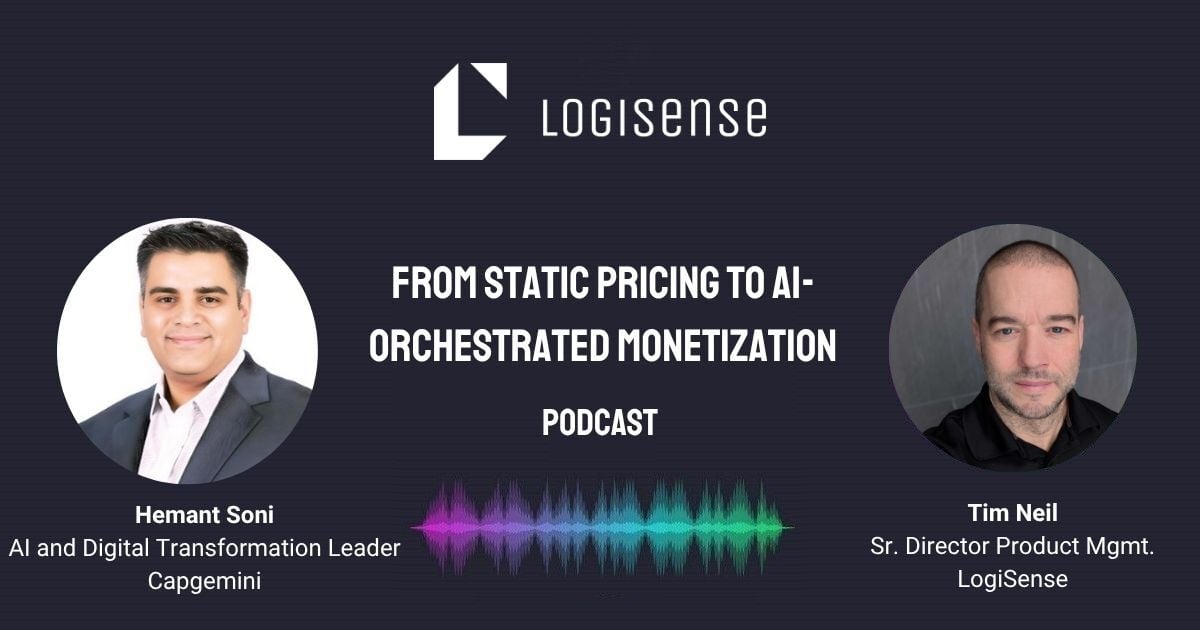
From Static Pricing to AI Orchestrated Monetization
For years, telecom and SaaS companies relied on predictable pricing models. Fixed bundles. Tiered plans. Standard contracts. That model is breaking.
Customer behavior is no longer predictable. Usage shifts daily. Expectations evolve in real time.
Hemant Soni, AI & Digital Transformation Leader at Capgemini, explains why static pricing can no longer keep up and what is replacing it. Watch now.

Continue learning

AI Pricing Lessons Learned from Telco
If you operate in AI, SaaS, CPaaS, or telecom, this episode will challenge how you approach pricing, packaging, and margin protection.
Ready to Modernize Your Monetization Strategy?
LogiSense Blog
Latest articles
Selecting a real-time usage rating platform requires more than comparing feature lists.
Product teams are under constant pressure to ship faster, add new capabilities, respond to customer demand, and increasingly, embed AI into their...
Every discussion about AI eventually arrives at the same question:
Usage-based pricing is giving SaaS companies more flexibility in how they package and sell their products. Instead of charging every customer the...
For years, network growth was relatively predictable.