

The Battle Of The Bill – The Fight For Control
An invoice is often viewed as the final step in the billing process, but in reality, it represents much more. It is a financial document, a customer communication tool, and a reflection of your brand.
Every invoice tells a story. It explains what the customer purchased, why they are being charged, how much they owe, and when payment is expected. For many organizations, it is also one of the most frequent touchpoints with customers.
Given its importance, it's no surprise that multiple departments believe they should own it.
The question is not whether Finance, Marketing, Customer Care, or IT should control invoices. The real question is how these teams can work together without slowing the business down.
Every Department Has a Stake in the Invoice
Invoices serve multiple business functions simultaneously.
Finance relies on invoices to collect revenue accurately and efficiently. Every line item, tax calculation, discount, and payment instruction must be correct to maintain financial integrity and regulatory compliance.
Marketing sees invoices differently. Every invoice represents an opportunity to reinforce the company's brand, communicate new services, promote upcoming offers, or strengthen customer relationships. Rather than being a purely transactional document, invoices can become an extension of the customer experience.
Customer Care depends on invoices to answer questions quickly and reduce unnecessary support calls. Clear descriptions, understandable usage details, and transparent charges help customers understand exactly what they are paying for.
Each department has legitimate priorities, which means invoice ownership is rarely straightforward.
The Real Bottleneck Is Often IT
Although business teams may decide what they want invoices to communicate, IT often determines what is actually possible.
Traditional billing systems place invoice templates, formatting, and business logic under the control of technical teams. Changes frequently require development work, testing cycles, deployment windows, and release approvals.
This creates a familiar situation.
Marketing wants to update promotional messaging.
Finance needs to comply with a new tax requirement.
Customer Care requests clearer usage descriptions to reduce support tickets.
All three departments submit requests, but they must wait for IT resources before any changes can be made.
IT is not creating unnecessary obstacles. These controls exist for good reasons. Billing platforms process sensitive financial information, and stability, security, and accuracy cannot be compromised.
However, when every invoice update becomes an IT project, the business loses agility.
Modern Businesses Need Greater Invoice Flexibility
Today's organizations update products, pricing, promotions, and customer communications far more frequently than they did just a few years ago.
Waiting weeks for simple invoice modifications no longer makes sense.
Business teams increasingly expect the ability to:
- Update invoice messaging without software releases.
- Introduce new branding or campaigns quickly.
- Modify layouts for different customer segments.
- Improve readability based on customer feedback.
- Respond to regulatory or compliance changes faster.
The goal is not to remove IT from the process. It is to allow business users to manage content while IT maintains governance, security, and platform stability.
What Makes an Effective Invoice?
An effective invoice does much more than request payment.
It helps customers understand exactly what they purchased while making payment as simple as possible.
A well-designed invoice should include:
- Clear customer information.
- Easy-to-understand product and service descriptions.
- Transparent usage and billing details.
- Accurate pricing, taxes, discounts, and totals.
- Straightforward payment instructions and due dates.
- Relevant messages, offers, or service updates where appropriate.
- Clean formatting that makes important information easy to find.
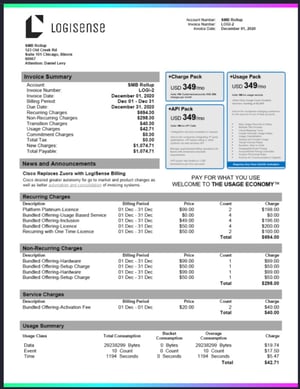
Small improvements in invoice clarity can reduce customer confusion, improve payment speed, and lower support costs.
Business Teams Should Control Content, Not Infrastructure
The most successful organizations separate content management from platform administration.
IT continues to oversee the billing platform, infrastructure, security, integrations, and governance.
Meanwhile, business users gain the flexibility to manage invoice templates, messaging, branding, and customer communications independently.
This collaborative model allows every department to focus on what it does best without creating unnecessary operational bottlenecks.
Instead of competing for ownership, Finance, Marketing, Customer Care, and IT become partners in delivering a better customer experience.
How LogiSense Simplifies Invoice Management
Modern billing platforms should empower business users without sacrificing enterprise control.
LogiSense Billing enables organizations to design and update invoice templates using familiar Microsoft Word tools rather than requiring specialist development skills.
Business teams can quickly modify layouts, messaging, and branding while maintaining access to comprehensive billing data and event-driven automation.
Templates can be uploaded, tested, validated, and deployed through controlled processes that preserve system integrity while reducing dependence on IT for everyday changes.
The result is a more collaborative approach to invoice management that improves agility without compromising governance.
Give Every Team the Control They Need
Invoices should never become a source of friction between departments.
When business users have the flexibility to manage customer communications and IT retains control over platform stability, organizations can respond faster to changing business requirements while delivering a better customer experience.
Rather than asking who should own the invoice, successful organizations focus on enabling every team to contribute where they create the most value.

Continue learning

Pricing Models & Customer Experience
Modernize Your Invoice Management
LogiSense Blog
Latest articles
Selecting a real-time usage rating platform requires more than comparing feature lists.
Product teams are under constant pressure to ship faster, add new capabilities, respond to customer demand, and increasingly, embed AI into their...
Every discussion about AI eventually arrives at the same question:
Usage-based pricing is giving SaaS companies more flexibility in how they package and sell their products. Instead of charging every customer the...
For years, network growth was relatively predictable.