
CCaaS providers can apply usage-based pricing to services such as automated interactions, transcription minutes, AI-generated summaries, sentiment analysis, agent-assist requests, voice processing, multilingual services, workflow executions, and successful self-service resolutions. The appropriate unit should be measurable, understandable to the customer, and closely connected to the cost or value of delivering the service.

Why Monetization Is Becoming the Contact Center Bottleneck
The modern Contact Center is undergoing one of the most significant transformations in its history. Artificial intelligence is no longer a future concept for CCaaS providers. It is actively reshaping how customer interactions are handled, how agents work, and how value is delivered at scale.
AI-powered self-service, real-time voice analytics, agent assist, sentiment detection, automated workflows, and proactive engagement are quickly becoming standard expectations rather than differentiators. Enterprises are investing aggressively to modernize customer experience, reduce operational friction, and meet rising customer expectations.
Yet beneath this rapid innovation lies a growing and often overlooked issue.
While CCaaS platforms are delivering more intelligence, more automation, and more measurable value, many are still monetizing their services as if nothing fundamental has changed.
The Monetization Gap in the Modern Contact Center
The 2026 January Market Study: Emerging Contact Center Technology shows that Contact Center and CCaaS leaders now expect measurable returns from technology investments within months, not years. AI initiatives are no longer pilots. They are operational, revenue-impacting, and deeply embedded into day-to-day service delivery.
Despite this shift, many CCaaS pricing models remain anchored in:
- Flat-rate subscriptions
- Per-seat licensing
- Static feature bundles
These approaches were designed for predictable usage patterns. AI-driven Contact Center environments are inherently variable.
AI introduces fluctuation across:
- Call duration and call volume
- Voice processing intensity
- Real-time analytics consumption
- Automated resolution rates
- Agent assist usage
- Multilingual and cross-region interactions
When pricing and billing remain static while usage becomes dynamic, value creation and revenue capture begin to drift apart.
Why AI Changes the Economics of CCaaS
AI does more than improve efficiency or service quality. It changes how Contact Center services are consumed.
In a modern CCaaS environment:
- Customers often begin with AI-driven self-service
- Voice AI handles intent detection and routing
- Transcription and sentiment analysis run continuously
- Agent assist tools surface guidance in real time
- Post-call automation generates summaries and insights
Each of these steps generates usage events. Each event carries cost, compute, and business value.
Most billing systems, however, were never designed to:
- Track granular AI-driven usage in real time
- Rate events dynamically across services
- Apply contract-specific pricing logic
- Support hybrid pricing models combining subscriptions, usage, and outcomes
As a result, CCaaS providers frequently absorb AI-related costs or bundle advanced capabilities into pricing models that fail to reflect actual consumption.
The Risk for CCaaS Providers
This disconnect creates tangible business risk.
Margin Pressure
AI services scale with usage, not seats. Without usage-aware monetization, operating costs rise faster than revenue.
Commercial Inflexibility
Enterprise customers increasingly expect pricing aligned to consumption or outcomes. Rigid billing systems make it difficult to support these models without heavy customization.
Slower Product Innovation
When monetization systems cannot support new pricing structures, product teams delay or limit launches. Innovation slows not because of technology constraints, but because revenue systems cannot keep up.
Over time, billing becomes the limiting factor in CCaaS growth.
Why Traditional Billing Systems Fall Short
Legacy billing platforms were built for a different era of the Contact Center.
They assume:
- Predictable call volumes
- Static service definitions
- Limited event types
- Simple subscription or seat-based pricing
AI-driven CCaaS environments demand:
- High-volume event ingestion
- Real-time rating and mediation
- Contract-specific pricing rules
- Support for tiered, usage-based, and outcome-driven models
- Transparent, auditable billing for enterprise customers
Without these capabilities, CCaaS providers face growing operational complexity and increasing exposure to revenue leakage.
When Value Creation Is Not Enough
Delivering better customer experiences is no longer the challenge. Capturing the value of those experiences is.
As CCaaS platforms introduce AI-driven capabilities, the gap between what is delivered and what is monetized widens unless pricing and billing evolve alongside the product.
This misalignment creates friction across the organization:
- Product teams struggle to commercialize innovation
- Finance teams lose visibility into margins
- Customers question pricing transparency
- IT teams absorb complexity through custom workarounds
Over time, this friction undermines scalability.
What CCaaS Leaders Should Be Asking
As AI becomes foundational to the Contact Center, CCaaS leaders must reassess their monetization readiness.
Key questions include:
- Can we track and rate AI-driven usage at scale?
- Can we support customer-specific pricing without creating operational debt?
- Can we launch new AI services without rebuilding billing logic?
- Can Finance see margin impact in near real time?
- Can customers clearly understand and trust their invoices?
If the answer to any of these is uncertain, monetization is already constraining growth.
Monetization as a Strategic Capability
The next phase of CCaaS competition will not be decided by AI features alone. It will be shaped by how effectively those features can be commercialized.
This requires:
- Event-driven billing architectures
- Flexible usage-based pricing models
- Contract enforcement at scale
- Real-time visibility into consumption and revenue
For CCaaS providers and Contact Center platforms, monetization can no longer be treated as a back-office function. It must evolve into a core platform capability.
Those that modernize early will be able to:
- Launch differentiated AI services faster
- Align pricing with value delivered
- Protect margins as usage scales
- Support enterprise complexity without excessive customization
Those that do not risk delivering more value while capturing less revenue.
Final Thought
AI is redefining the Contact Center. CCaaS platforms are moving quickly to meet customer expectations and operational demands.
The question is no longer whether AI belongs in the Contact Center.
It is whether monetization systems are ready for the scale, variability, and complexity AI introduces.
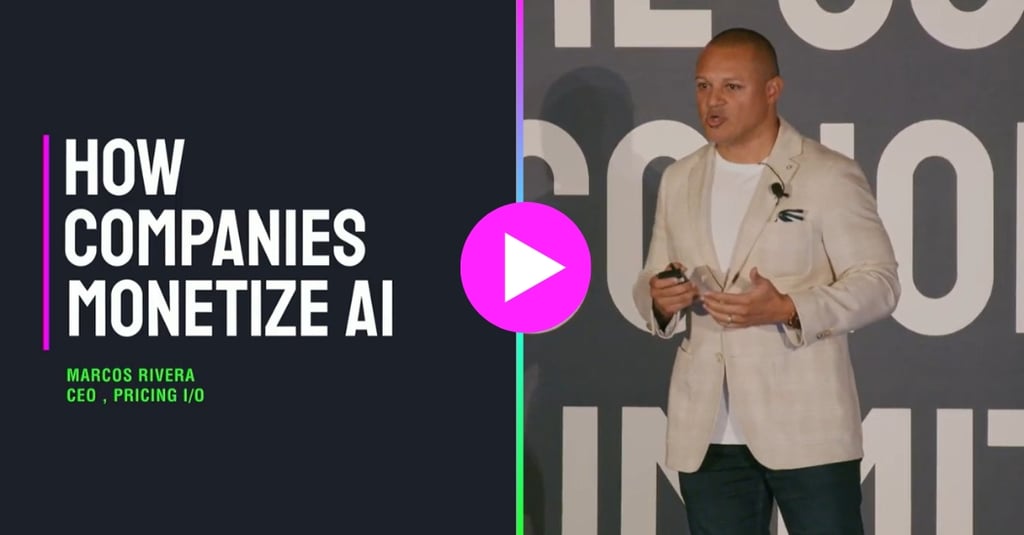
How Companies Monetize AI
As the AI gold rush continues, only a few are turning hype into real revenue. This session with Marcos Rivera, CEO at Pricing I/O, cuts through the noise to explore what’s actually working for startups monetizing AI. From pricing models and product design to customer acquisition strategies, learn the patterns investors are watching and the tactics leading companies are using to turn AI capabilities into scalable businesses.
Frequently Asked Questions
Which contact center services can be monetized based on usage?
Do CCaaS providers need to replace per-seat pricing entirely?
No. Per-seat pricing can remain appropriate for access to the core platform, agent licenses, administrative capabilities, and predictable service entitlements. Many providers can introduce a hybrid model that combines a recurring platform or seat fee with usage charges for variable AI and automation services. This preserves predictable recurring revenue while accounting for services whose costs increase with consumption.
How does raw contact center activity become billable usage?
Raw activity must first be collected from sources such as communication platforms, AI services, workflow applications, and analytics systems. Mediation then validates, normalizes, enriches, and aggregates these records before they are rated according to the customer’s contract. This process converts large volumes of technical events into accurate, auditable usage that can be invoiced and explained to the customer.
Can a modern monetization platform work with an existing CCaaS technology stack?
A monetization platform does not necessarily require the replacement of the existing CCaaS platform, CRM, CPQ, ERP, or financial systems. It can operate as a specialized layer that receives usage data, applies pricing and contract rules, calculates charges, and sends the resulting information to downstream invoicing and financial applications. This allows providers to modernize monetization while preserving investments in their wider technology environment.
How should a CCaaS provider begin modernizing AI monetization?
A practical starting point is to select one AI-powered service with identifiable usage, material delivery costs, and clear customer value. The provider can then define the billable event, validate the available usage data, model the pricing structure, establish customer-facing reporting, and test the process with a limited group of customers. Starting with a contained use case helps expose data and operational gaps before the model is extended across the broader product portfolio.

Ali Naqvi is a Product Marketing Manager at LogiSense, where he focuses on monetization strategy, usage-based business models, and the evolving economics of SaaS, telecom, and AI-driven services. With over a decade of experience in B2B marketing and demand generation, Ali writes about the intersection of pricing innovation, quote-to-cash transformation, and monetization infrastructure. His work explores how organizations can adapt their commercial operations to support hybrid pricing models, AI consumption, and the growing complexity of modern digital services.
Continue learning

Podcast
How Leading Companies Are Monetizing AI Without Losing Control
AI-powered contact center services create new revenue opportunities, but also introduce pricing and billing complexity. Learn how leading organizations are adapting monetization strategies for AI-driven offerings while maintaining operational and financial control.
Speak With an expert
Are You Ready for AI-Powered Contact Centers?
As AI-powered contact center offerings evolve, monetization complexity grows. Speak with a LogiSense expert to identify billing limitations, revenue leakage risks, and opportunities to launch flexible pricing models that support profitable growth.
LogiSense Blog
The LogiSense blog explores advanced billing solutions, focusing on usage-based pricing, monetization strategies, revenue assurance, and SaaS innovations to help businesses optimize billing processes and adapt to the evolving usage economy.
Latest articles
How to Evaluate a Real-Time Usage Rating Platform
Selecting a real-time usage rating platform requires more than comparing feature lists.
Pricing Should Not Be the Last Step in Product Development
Product teams are under constant pressure to ship faster, add new capabilities, respond to customer demand, and increasingly, embed AI into their...
AI Monetization Starts Where Pricing Strategy Ends
Every discussion about AI eventually arrives at the same question:
Real-Time Usage Rating: A Guide for SaaS Finance Teams
Usage-based pricing is giving SaaS companies more flexibility in how they package and sell their products. Instead of charging every customer the...
AI Agents Are Rewriting Network Economics
For years, network growth was relatively predictable.