
No. A usage-driven strategy can support subscription, usage-based, or hybrid pricing. A company may retain a recurring subscription while adding usage allowances, overage charges, credits, volume tiers, or consumption-based expansion. The right model depends on how customers receive value, how usage varies, and how much spending predictability buyers require.

Usage-Driven GTM Strategies
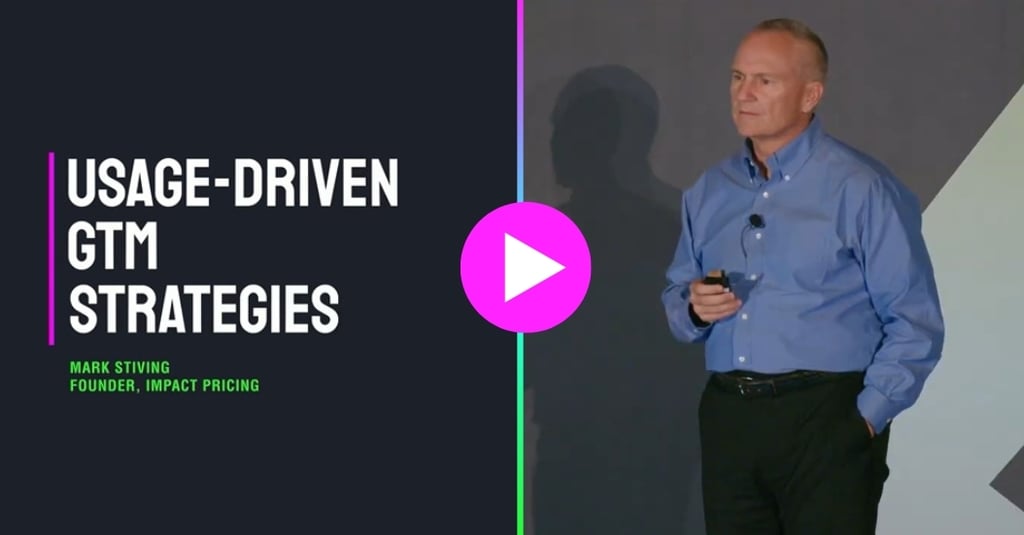
Pricing expert Mark Stiving delivered a clear reminder at the Usage Economy Summit 2025 that revenue growth in subscription businesses is not accidental. It is the result of disciplined choices about value, segmentation, packaging, and pricing metrics. For companies operating in recurring revenue models, his message was both simple and demanding. Growth requires mastery of three revenue buckets: winning customers, keeping customers, and growing customers. Each one must be managed deliberately.
Buyers Pay for Value, Not Products
Mark began with the fundamental principle that drives all purchase decisions. Buyers trade money for value. In practice, this means that customers evaluate whether a product will help them make more money or reduce costs. Every pricing decision should reflect this reality.
In traditional perpetual license models, companies grew by increasing sales and marketing spend to acquire new customers. Recurring revenue businesses operate differently. The initial transaction is often smaller, and long term value is created only when customers stay, use the product, and increase their spend over time. Retention and expansion become powerful sources of revenue stability and growth.
The Three Revenue Buckets: Win, Keep, Grow
Mark’s framework for subscription success centers on three buckets that must be managed independently.
Win: Attracting and converting new customers.
Keep: Ensuring customers realize value so they renew.
Grow: Expanding revenue within the existing customer base through higher usage, upsells, cross-sells, or price increases.
Every business decision should support at least one of these buckets, and in a mature SaaS business the “grow” bucket becomes increasingly important. It may not feel urgent, but its impact on long term revenue is undeniable.
Three Levers That Shape Value
Mark identified three strategic levers that determine whether a company can capture the full value it creates.
1. Market Segmentation
Market segments should be defined by the problems customers are trying to solve rather than by industry, geography, or company size. Choosing the right segment sharpens messaging, improves product-market fit, and lays the foundation for differentiated pricing.
Platforms that serve many use cases risk being undervalued when sold as broad, undifferentiated offerings. Turning a platform into a segment-specific solution creates pricing power. He used LinkedIn as an example. Instead of a single offering, LinkedIn built distinct solutions for Recruiters, Sales professionals, Job Seekers, and general Professionals. Value becomes clearer. Willingness to pay rises.
2. Packaging
Packaging should be crafted inside each market segment. Good-Better-Best structures, when aligned with segment needs, offer customers a transparent and intuitive way to upgrade. Packaging also creates internal clarity. Teams know where new features belong and customers understand the trade-offs between tiers.
3. Pricing Metrics
The pricing metric defines what the customer is paying for. Strong metrics correlate closely with the customer’s own value metrics. In B2B, value is often measured in incremental profit. Companies must understand the KPIs that signal profit improvements and design pricing around those KPIs. When the metric aligns with value, customers accept higher usage, expansion becomes easier, and pricing grows more durable.
A misaligned metric, by contrast, leaves value uncaptured. Mark shared an example of a legal software provider that charged per user. Small firms paid more because lawyers used the tool directly, while large firms centralized usage with a few admins and paid less despite receiving far more value. The wrong metric limited revenue.
Why Companies Underinvest in Expansion
Despite its importance, expansion is often neglected. Mark explained why. Acquiring and retaining customers feel urgent. Expansion rarely does. No one is fired for a flat NRR number, but the long term impact of weak expansion is severe.
To expand effectively, companies must operationalize four levers:
- Price increases when value delivered grows.
- Upsells such as Good to Better or Better to Best.
- Cross-sells for adjacent solutions.
- Usage based growth driven by value aligned metrics.
Successful SaaS businesses plan for all four. None happen on their own.
A Value Architecture for Clearer Monetization
Stiving offered a structure for understanding how customers make decisions and how companies should align their pricing and packaging accordingly. It includes three layers.
Foundational Problem: Why customers buy the category at all. -> Guides segmentation and top level messaging.
Problem Scope: The customer’s specific needs and context. -> Guides packaging decisions and metric selection.
Situational Context: The conditions at the moment of purchase. -> Guides price segmentation and discounting.
Uber served as an illustration. Although the company handles many use cases, behind the scenes Uber organizes around three segments: people, food, and packages. Inside each segment are different packages, each optimized for a specific problem scope. Customers see a simple interface, while the underlying monetization structure is highly engineered. This is the blueprint for scalable pricing.
Aligning Sales With Value
The same value architecture applies to sales motions. Value-based prospecting identifies customers with strong problems. Consultative discovery quantifies the impact of solving those problems. Negotiation focuses on the value created, not arbitrary rates. Compensation, discount authority, and playbooks must reinforce this value centric approach.
Final Thought
Mark ended with a practical rule. If some customers extract significant value but pay very little, the pricing metric is almost certainly wrong. Companies that fix this problem unlock hidden expansion revenue and strengthen the integrity of their entire pricing strategy.
Watch Mark’s presentation to learn the practical pricing frameworks, value strategies, and growth levers that top recurring-revenue companies use to win, keep, and grow customers more effectively.
Frequently Asked Questions
Does a usage-driven GTM strategy require fully usage-based pricing?
How can usage data help identify customer expansion opportunities?
Usage data can reveal when customers are approaching limits, adopting additional capabilities, increasing transaction volumes, or receiving greater value from the product. Sales and customer success teams can use these signals to initiate relevant conversations about upgrades, additional capacity, new packages, or complementary services. The objective is to connect expansion offers to demonstrated customer needs rather than relying on generic upselling.
Which teams should be responsible for a usage-driven GTM strategy?
Responsibility should be shared across product, pricing, sales, marketing, customer success, finance, and billing operations. Product and customer-facing teams help define how value is created and measured, while finance and monetization teams ensure the resulting offers can be priced, metered, billed, and recognized accurately. Clear ownership is still required, but the strategy cannot be developed effectively within one department alone.
What operational capabilities are needed to support usage-driven growth?
Companies need systems that can collect and validate usage data, apply pricing rules, support multiple packaging and pricing models, and provide visibility into customer consumption. Usage information should also flow into CRM, customer success, billing, and financial systems so teams can recognize expansion signals, manage customer expectations, and invoice accurately as consumption changes.

Ali Naqvi is a Product Marketing Manager at LogiSense, where he focuses on monetization strategy, usage-based business models, and the evolving economics of SaaS, telecom, and AI-driven services. With over a decade of experience in B2B marketing and demand generation, Ali writes about the intersection of pricing innovation, quote-to-cash transformation, and monetization infrastructure. His work explores how organizations can adapt their commercial operations to support hybrid pricing models, AI consumption, and the growing complexity of modern digital services.
Continue learning

Analyst Report
How Monetization Leaders Are Adapting to Usage-Based Growth
Discover how leading organizations are evolving pricing, packaging, and monetization strategies to support usage-based and hybrid business models. Gain insights from executives navigating the same challenges discussed in this article.
Strategy Assessment
Can Your Monetization Infrastructure Support Usage-Driven Growth?
Usage-driven GTM strategies often expose weaknesses in pricing operations, billing, revenue recognition, and customer lifecycle management. Speak with a LogiSense monetization expert to assess whether your current systems can support the business models you want to launch.
LogiSense Blog
The LogiSense blog explores advanced billing solutions, focusing on usage-based pricing, monetization strategies, revenue assurance, and SaaS innovations to help businesses optimize billing processes and adapt to the evolving usage economy.
Latest articles
How to Evaluate a Real-Time Usage Rating Platform
Selecting a real-time usage rating platform requires more than comparing feature lists.
Pricing Should Not Be the Last Step in Product Development
Product teams are under constant pressure to ship faster, add new capabilities, respond to customer demand, and increasingly, embed AI into their...
AI Monetization Starts Where Pricing Strategy Ends
Every discussion about AI eventually arrives at the same question:
Real-Time Usage Rating: A Guide for SaaS Finance Teams
Usage-based pricing is giving SaaS companies more flexibility in how they package and sell their products. Instead of charging every customer the...
AI Agents Are Rewriting Network Economics
For years, network growth was relatively predictable.