
Subscription pricing may become limiting when customer usage varies significantly, expansion revenue depends on contract renegotiations, or customers regularly pay for capacity they do not use. It may also be time to evolve when new features, AI capabilities, API consumption, transactions, or data volumes create costs and value that are not reflected accurately in a fixed recurring fee.

Why SaaS Businesses Must Evolve to Usage-Based Pricing
For over a decade, SaaS businesses have thrived on subscription-based pricing models. Predictable revenue, simplified billing, and scalability made it the default for GTM and finance leaders alike. But as customer expectations evolve and enterprise buyers demand more flexibility, a new model is emerging as the gold standard: Usage-Based Pricing (UBP).
This isn’t just a trend, it’s a structural shift in how software is bought, sold, and valued.
1. From “Buyers” to Users”: The GTM Shift
Modern GTM teams are no longer selling to a procurement department once a year. Instead, product adoption, user engagement, and daily utility are at the core of every deal. SaaS buyers now behave more like users. They want to pay in proportion to what they use.
This shift fundamentally breaks the traditional license or per-seat pricing model. If your pricing model doesn’t match how your customers extract value, your conversion, expansion, and retention metrics will suffer.
UBP aligns revenue with value. It lets you land smaller, then expand effortlessly, making GTM plays like product-led growth (PLG), freemium, or usage trials more natural and effective.
“The winners in SaaS today are those who remove friction, not those who maximize commitment upfront.”
2. Customer Expectations Are Evolving Faster Than Your SKUs
Finance leaders are increasingly scrutinizing every contract, looking for elasticity, ROI clarity, and variable cost structures. Fixed-rate subscriptions look like a liability in a world dominated by cloud services, generative AI, and real-time decisioning.
Enterprises expect to scale down when needed and ramp up without renegotiation. UBP enables this. When pricing becomes a lever customers can control, they feel empowered, not trapped.
This not only improves satisfaction but also reduces churn—especially for complex enterprise SaaS with multiple use cases, departments, or seasonal volumes.
3. AI and GenAI Are Accelerating the Need for Pricing Agility
AI-driven workflows, inference requests, session-based co-pilots, and data usage volumes vary by customer, use case, and month. You cannot monetize AI with a flat rate.
This has become painfully clear in the market:
- Microsoft Copilot is priced per user plus per token consumption.
- OpenAI offers pay-as-you-go pricing on GPT APIs.
- Databricks, Snowflake, and Stripe all rely on consumption-based billing to stay competitive and adaptable.
If your SaaS platform incorporates any AI, GenAI, or data analytics features, UBP is the only model that reflects how value is consumed.
4. CAC is Rising. UBP Increases LTV and Net Expansion
Customer Acquisition Cost (CAC) is at an all-time high. GTM leaders are under pressure to justify spend with stronger Lifetime Value (LTV) and better NRR (Net Revenue Retention).
Usage-Based Pricing helps in two key ways:
- Low-friction entry: Smaller initial commitments make it easier to acquire customers.
- Elastic expansion: As users adopt more functionality, usage (and revenue) scales automatically.
Rather than battling through upsell cycles, UBP allows for natural, usage-driven expansion. In effect, your product becomes the sales rep.
5. From Product Teams to Pricing Committees: UBP Requires Cross-Functional Maturity
UBP forces internal alignment between GTM, Product, and Finance. That’s a feature, not a bug.
- GTM teams get better forecasting tools and incentive alignment.
- Product teams gain clarity on feature adoption and monetization.
- Finance teams benefit from granular revenue analytics and improved margin control.
Yes, the transition takes effort. But SaaS companies that adopt UBP gain strategic agility, market differentiation, and deeper customer loyalty.
Ready to Move? Avoid These Common Pitfalls
Many companies attempting UBP stumble because they underestimate the operational lift.
- Legacy billing systems can’t handle granular usage data, mediation, or dynamic rating.
- Sales teams need new comp models.
- Finance needs to model deferred revenue, usage thresholds, and carry forward.
That’s where a purpose-built billing platform like LogiSense becomes essential. With proven deployments across SaaS, Telco, and IoT businesses, LogiSense empowers pricing innovation without sacrificing control or compliance.
Final Thoughts: Monetization is Strategy
In a dynamic market, pricing is not just a financial decision, it’s a product and GTM decision. Your business model must reflect how your customers succeed with your software.
SaaS companies that evolve to usage-based pricing don’t just price better, they win more, grow faster, and retain longer.
The transition may be challenging, but the cost of inaction is greater. Your competitors are already moving. The question isn’t if you should adopt usage-based pricing, it’s how fast you can get there.
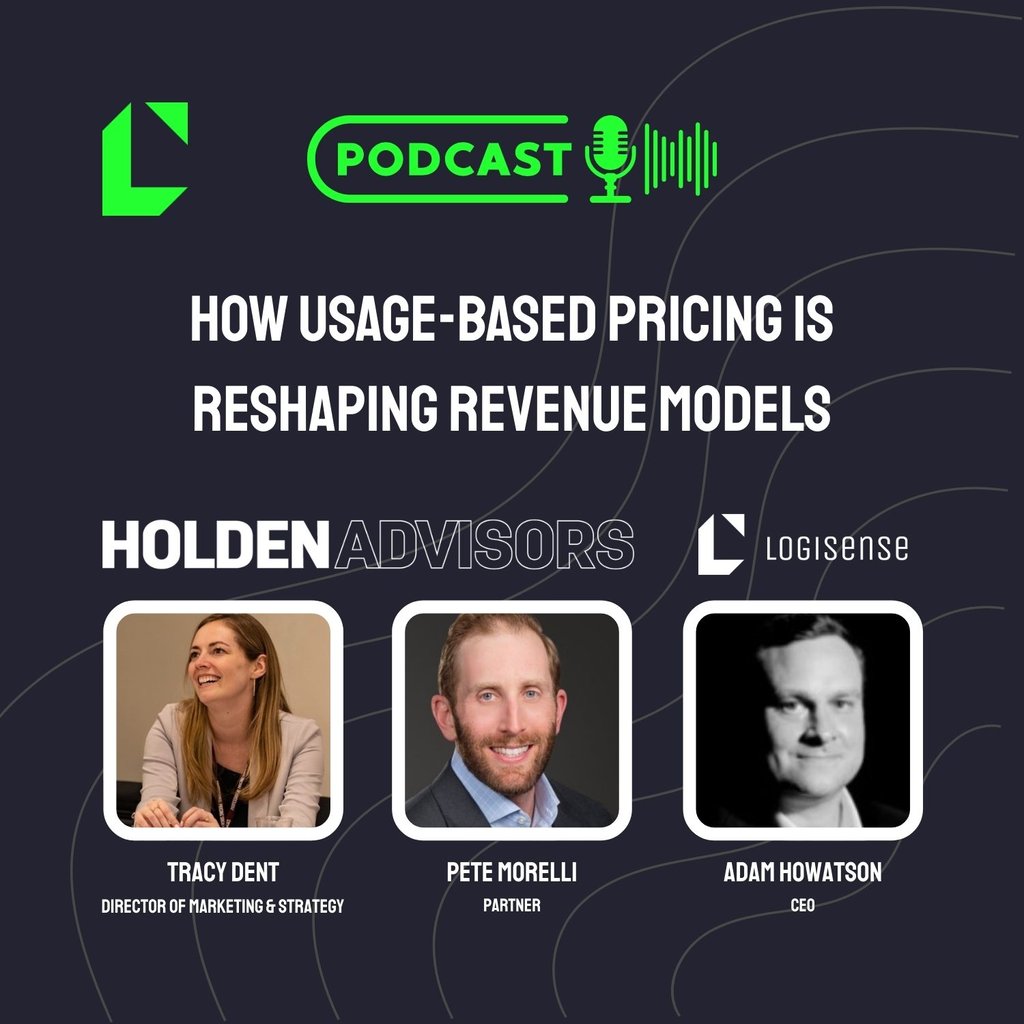
WATCH: How Usage-Based Pricing Is Reshaping Revenue Models
In this episode of If Prices Could Talk, Adam Howatson, CEO of LogiSense, joins Pete Morelli and Tracy Dent of Holden Advisors to explore how usage-based pricing is helping companies future-proof their business models and win in markets where expectations are shifting fast.
Frequently Asked Questions
How can a SaaS company tell when subscription pricing is no longer sufficient?
Should SaaS companies adopt usage-based pricing or a hybrid model?
For many SaaS companies, a hybrid model is the most practical starting point. It combines a recurring subscription or platform fee with variable charges based on consumption. This preserves a degree of revenue predictability while allowing customer spend to grow alongside product usage and value.
How does usage-based pricing affect SaaS revenue forecasting?
Usage-based pricing introduces more variability because revenue depends partly on customer consumption. Forecasting therefore requires reliable usage data, historical consumption patterns, customer commitments, seasonality, and visibility into changes in product adoption. Minimum commitments, prepaid credits, thresholds, and hybrid fees can help improve predictability.
What makes a good usage metric for a SaaS product?
A strong usage metric should be measurable, easy for customers to understand, and closely connected to the value the product delivers. Depending on the service, this could include transactions, API calls, data processed, messages sent, active devices, compute time, AI tokens, or completed business outcomes.
How can SaaS companies introduce usage-based pricing without disrupting existing customers?
Companies can reduce disruption by introducing the model gradually, testing it with new products or customer segments, and providing clear usage visibility before changing how customers are billed. Existing customers may be migrated through contract renewals, optional hybrid plans, usage allowances, or transitional pricing that limits unexpected cost changes.
Which teams need to be involved in a usage-based pricing transition?
A successful transition usually involves product, finance, sales, revenue operations, customer success, engineering, and billing teams. Product determines how value and usage are measured, finance evaluates revenue and margin implications, sales communicates the model, and technical teams ensure usage is captured, rated, invoiced, and explained accurately.

Adam Howatson stands at the forefront of the technology and software industry as the president and chief executive officer of LogiSense. Joining the company in January 2019, he has been instrumental in executing its strategy, while also serving as a member of the board of directors.
Continue learning

White paper
Designing Pricing Models for a Changing Market
Learn how leading organizations evaluate pricing strategies, align pricing with customer value, and build monetization models that support long-term growth and profitability.
Speak with an expert
Can Your Billing Platform Support Your AI Pricing Strategy?
Speak with a LogiSense expert to identify billing limitations, monetization gaps, and operational challenges that could prevent your pricing strategy from scaling profitably.
LogiSense Blog
The LogiSense blog explores advanced billing solutions, focusing on usage-based pricing, monetization strategies, revenue assurance, and SaaS innovations to help businesses optimize billing processes and adapt to the evolving usage economy.
Latest articles
How to Evaluate a Real-Time Usage Rating Platform
Selecting a real-time usage rating platform requires more than comparing feature lists.
Pricing Should Not Be the Last Step in Product Development
Product teams are under constant pressure to ship faster, add new capabilities, respond to customer demand, and increasingly, embed AI into their...
AI Monetization Starts Where Pricing Strategy Ends
Every discussion about AI eventually arrives at the same question:
Real-Time Usage Rating: A Guide for SaaS Finance Teams
Usage-based pricing is giving SaaS companies more flexibility in how they package and sell their products. Instead of charging every customer the...
AI Agents Are Rewriting Network Economics
For years, network growth was relatively predictable.