

Welcome to the Usage Economy®
For years, subscription pricing has been the default business model for SaaS companies and digital service providers. It brought predictable recurring revenue, simplified purchasing, and helped businesses scale quickly.
But customer expectations have changed.
Today's buyers expect pricing that reflects the value they actually receive. Whether they're consuming AI services, cloud infrastructure, APIs, IoT connectivity, or communications platforms, they increasingly want the flexibility to pay based on how much they use, not simply because another month has passed.
This shift is giving rise to the Usage Economy®, where businesses align pricing with customer consumption, outcomes, and value rather than fixed plans alone.
For organizations building AI-powered products, cloud services, telecommunications platforms, or connected devices, this is becoming a competitive advantage rather than simply a billing decision.
What Is the Usage Economy?
The Usage Economy describes a shift away from one-size-fits-all pricing toward business models that adapt to how customers consume products and services.
Instead of relying solely on fixed subscriptions, organizations are combining recurring charges with flexible pricing models such as:
- Usage-based pricing
- Consumption-based pricing
- Hybrid pricing
- Pay-as-you-go
- Credit-based pricing
- Token-based pricing for AI
- Outcome-based pricing
Rather than asking customers to fit predefined pricing tiers, businesses design pricing that better reflects real customer value.
This creates a stronger relationship between customer success and business growth.
Why Traditional Subscription Models Are No Longer Enough
Subscriptions remain an important part of modern software businesses, but on their own they often struggle to accommodate today's consumption patterns.
Consider a few familiar examples.
A customer may provision thousands of IoT devices months before they become active.
An enterprise might launch an AI assistant that experiences unpredictable spikes in usage.
A communications provider may have customers with dramatically different calling or messaging volumes.
Charging every customer the same monthly fee in these situations rarely reflects either the provider's costs or the customer's perceived value.
As products become more dynamic, pricing must become more dynamic as well.
AI Is Accelerating the Usage Economy
Artificial intelligence has fundamentally changed how digital services are consumed.
Unlike traditional software, AI generates variable costs every time a customer submits a prompt, processes data, invokes an API, or interacts with an autonomous agent.
Infrastructure costs fluctuate based on GPU utilization, model selection, token consumption, and inference workloads.
This makes fixed subscription pricing increasingly difficult to sustain.
Many AI companies are therefore adopting monetization models that combine subscriptions with usage, credits, or token-based billing to protect margins while giving customers greater flexibility.
For businesses building AI products, pricing is no longer just a commercial decision. It has become an operational requirement.
Hybrid Pricing Is Becoming the New Standard
One common misconception is that businesses must choose between subscriptions and usage-based pricing.
In reality, many of today's fastest-growing companies combine both.
A hybrid pricing model might include:
- A recurring platform subscription
- Usage-based charges
- Included monthly credits
- Overage pricing
- Premium features
- Professional services
This allows businesses to maintain predictable recurring revenue while ensuring pricing scales alongside customer growth.
Hybrid pricing also makes it easier to launch new services without redesigning the entire commercial model.
What the Usage Economy Looks Like Across Industries
SaaS
Software vendors increasingly monetize premium capabilities through usage while maintaining recurring platform subscriptions.
Artificial Intelligence
AI providers bill customers based on tokens, prompts, API requests, GPU usage, or autonomous agent activity.
Communications
CPaaS, UCaaS, and CCaaS providers monetize minutes, messages, channels, recordings, and AI-powered customer interactions.
IoT
Connected products generate millions of usage events that can be monetized individually or bundled into flexible pricing plans.
Cloud Infrastructure
Cloud platforms have demonstrated how consumption-based pricing enables customers to scale resources without rigid commitments.
Operationalizing the Usage Economy
Flexible pricing creates new opportunities, but it also introduces operational complexity.
Organizations must accurately collect, process, rate, and invoice enormous volumes of usage data while supporting customer-specific pricing, contract terms, and financial compliance.
This requires more than a billing engine.
Businesses need a monetization platform capable of:
- Processing high-volume usage data
- Supporting subscription and usage billing together
- Rating complex pricing models
- Managing customer-specific contracts
- Automating invoicing
- Integrating with ERP, CRM, and finance systems
- Supporting revenue recognition requirements
Without this operational foundation, innovative pricing models quickly become difficult to scale.
Benefits of the Usage Economy
Organizations that successfully embrace the Usage Economy can:
- Better align pricing with customer value
- Reduce subscription fatigue
- Improve customer retention
- Launch new products faster
- Support AI and emerging digital services
- Protect profit margins as costs fluctuate
- Create pricing models that evolve alongside customer needs
Most importantly, they remove friction between innovation and monetization.
The Future of Monetization
The Usage Economy is not replacing subscriptions.
It is expanding how businesses think about monetization.
As AI, cloud computing, telecommunications, and connected services continue to evolve, organizations will increasingly combine subscriptions, usage, outcomes, and consumption into flexible commercial models that better reflect how customers create value.
Businesses that modernize their monetization capabilities today will be better positioned to launch new services, adapt pricing strategies, and respond to changing market expectations tomorrow.
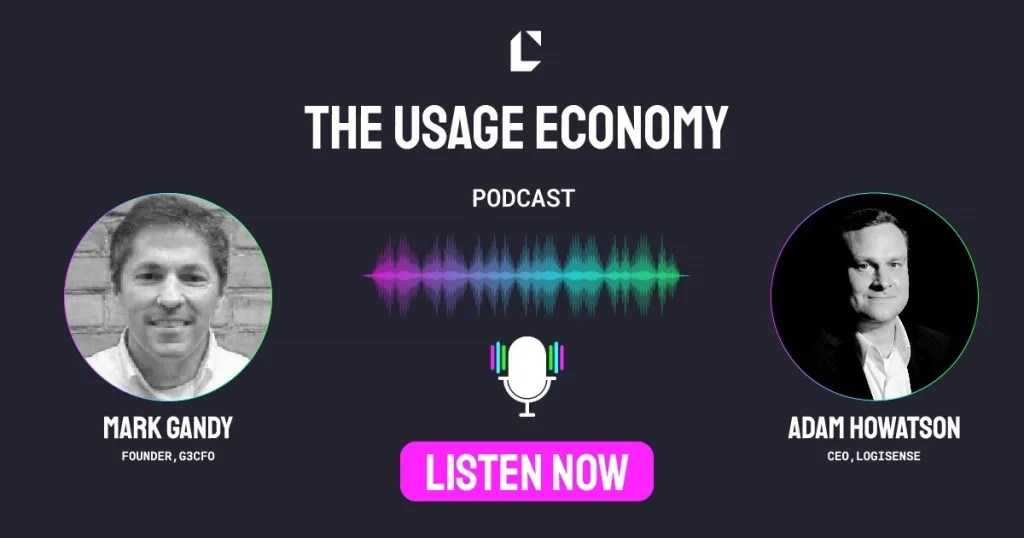
Listen to the Usage Economy Podcast with Mark Gandy
Dive into the latest episode of the CFO Bookshelf podcast discussing the Usage Economy with our CEO, Adam Howatson, and Mark Gandy, Founder, G3CFO.

Continue learning

From Static Pricing to AI Orchestrated Monetization
Ready to Build for the Usage Economy?
LogiSense Blog
Latest articles
Selecting a real-time usage rating platform requires more than comparing feature lists.
Product teams are under constant pressure to ship faster, add new capabilities, respond to customer demand, and increasingly, embed AI into their...
Every discussion about AI eventually arrives at the same question:
Usage-based pricing is giving SaaS companies more flexibility in how they package and sell their products. Instead of charging every customer the...
For years, network growth was relatively predictable.