

Why Embracing the Usage Economy is Your Key to Competitive Advantage
The Usage Economy® is transforming how businesses create, deliver, and monetize value. Customers increasingly expect to pay for what they use rather than fixed subscriptions, forcing companies to rethink traditional pricing models and embrace more flexible approaches to monetization.
Whether you're paying for cloud infrastructure through Amazon Web Services (AWS), using AI models charged by tokens or API calls, subscribing to telecommunications services, or tracking connected assets through IoT devices, you're already participating in the Usage Economy®. Rather than charging every customer the same fixed fee, businesses are aligning pricing with actual consumption, creating a fairer experience for customers while unlocking new revenue opportunities.
This shift extends far beyond software. Industries including telecommunications, IoT, transportation and logistics, utilities, healthcare, manufacturing, media, and financial services are increasingly adopting usage-based and hybrid pricing models to better reflect the value customers receive.
Connected products have accelerated this transformation. Modern devices generate enormous amounts of operational and customer data, giving organizations unprecedented visibility into how products are used. These insights enable businesses to design more competitive pricing models, launch new services faster, improve customer retention, and continuously refine their offerings based on real-world consumption patterns.
At the same time, artificial intelligence is accelerating the shift toward usage-based monetization. AI services consume computing resources with every prompt, inference, or agent interaction, making fixed subscriptions increasingly difficult to sustain. As organizations invest heavily in AI infrastructure, pricing based on actual usage has become one of the most effective ways to balance customer value with profitability.
The move toward usage-based monetization is no longer driven solely by customer preference. It is becoming a business imperative. Organizations need pricing models that adapt to fluctuating demand, support rapid product innovation, and accurately monetize every service they deliver.
Businesses that fail to evolve risk more than losing customers. They risk limiting innovation, constraining revenue growth, and falling behind competitors that can launch new pricing models in days rather than months.
The organizations leading the Usage Economy® understand a fundamental truth: pricing is no longer simply a financial decision. It has become a strategic product capability and a powerful competitive advantage.
From Ownership to Access: The New Competitive Edge
The most successful businesses no longer compete solely by selling products. They compete by delivering outcomes.
Over the past two decades, customer expectations have fundamentally shifted from ownership to access. Consumers and businesses alike increasingly value flexibility over long-term commitments, paying only for the services, resources, or outcomes they actually consume.
This transformation has reshaped entire industries. Uber became one of the world's largest transportation platforms without owning a fleet of vehicles. Airbnb created one of the world's largest hospitality marketplaces without building hotels. Amazon Web Services redefined enterprise infrastructure by allowing organizations to consume computing resources on demand instead of investing in expensive hardware.
Artificial intelligence is now driving the next phase of this evolution. AI providers increasingly charge based on tokens processed, API requests, GPU consumption, agent executions, or business outcomes rather than traditional seat licenses. Customers expect pricing that scales alongside the value they receive, while providers need monetization models that protect increasingly expensive infrastructure investments.
The shift toward access-based consumption extends well beyond software. Manufacturers are introducing equipment-as-a-service offerings, transportation providers are charging for premium operational services, healthcare organizations are expanding outcome-based care models, and utilities continue to optimize pricing based on actual consumption patterns.
Organizations that continue relying on rigid, one-size-fits-all pricing risk creating friction for customers whose needs evolve over time. Flexible pricing allows businesses to better align revenue with customer success while improving competitiveness in increasingly dynamic markets.
Economic uncertainty has only reinforced this trend. Supply chain disruptions, inflation, fluctuating energy costs, and evolving customer demand have made fixed pricing models increasingly difficult to maintain. Businesses need pricing strategies that adapt as quickly as market conditions change.
Transportation and logistics providers offer a strong example. Rather than charging solely by weight and distance, many organizations now monetize additional services such as refrigeration, priority delivery, warehouse storage, specialized handling, and real-time tracking. Each service creates incremental customer value and represents an opportunity to generate additional revenue, provided the organization has the ability to accurately capture, rate, and bill for that usage.
The companies thriving in today's economy are not simply selling products more efficiently. They are continuously discovering new ways to monetize the value they already create.
The X Factor: Understanding Your Value Exchange
Every successful business creates value. The challenge is identifying exactly what customers are willing to pay for.
Many organizations define their products by what they build rather than the outcomes they deliver. They calculate their costs, add a margin, and assume customers will perceive the same value. In today's Usage Economy®, that approach is increasingly outdated.
The companies winning today start with a different question:
What is the measurable value our customers receive?
For Uber, the answer is straightforward. Customers don't pay for access to a mobile app. They pay to get from one location to another.
For Amazon Web Services, customers don't purchase servers. They pay for the computing power, storage, and services they actually consume.
For AI providers, customers aren't simply buying software licenses. They're paying for tokens processed, AI agents executed, documents analyzed, images generated, or business tasks completed.
The value exchange varies from industry to industry, but the principle remains the same. Customers are willing to pay for measurable outcomes that help them achieve their objectives.
Once organizations identify that value exchange, they can begin designing pricing models that better reflect how customers consume their products and services.
Value Is More Than Volume
One of the biggest misconceptions about usage-based pricing is that everything must be billed per transaction or per unit consumed.
In reality, organizations have far more flexibility.
Usage can be measured in countless ways, including:
- API calls
- AI tokens processed
- Minutes of service
- Gigabytes transferred
- Connected devices
- Active users
- Transactions processed
- Workflows completed
- Business outcomes achieved
- Events detected
- Resources consumed
- Revenue generated
Many organizations also combine multiple value metrics into hybrid pricing models. A customer may pay a recurring platform subscription alongside usage charges, prepaid credits, overage fees, or outcome-based incentives. This approach creates predictable revenue for the provider while giving customers the flexibility they increasingly expect.
The most successful pricing strategies rarely rely on a single metric. Instead, they align pricing with how customers perceive value throughout their lifecycle.
Not All Usage Creates Equal Value
Another common mistake is assuming every unit of consumption should cost the same.
In reality, different usage events often create dramatically different business value.
Consider an IoT deployment monitoring an oil pipeline.
Thousands of sensors may continuously transmit routine operational data indicating that everything is functioning normally. These messages are important, but relatively low in value.
Now imagine one sensor detects a pressure anomaly indicating a potential leak.
That single event could prevent millions of dollars in environmental damage, regulatory penalties, operational downtime, and reputational harm.
Both events generate data, but they are far from equal in value.
The same principle applies across industries.
A logistics provider may charge premium rates for refrigerated transportation, hazardous materials handling, or expedited delivery.
A cloud provider may apply different pricing based on compute resources, storage tiers, or geographic regions.
An AI platform may charge differently depending on the model selected, response speed, reasoning complexity, or GPU resources required.
Organizations that understand these differences can create pricing models that better reflect the value customers receive instead of simply charging for raw consumption.
Pricing Becomes a Competitive Advantage
This is where pricing shifts from being a finance function to becoming a strategic growth lever.
When organizations understand both their costs and the value delivered to customers, they gain the flexibility to innovate without sacrificing profitability.
Instead of forcing every customer into Bronze, Silver, and Gold packages, they can introduce pricing models tailored to different buying behaviors, industries, usage patterns, and customer segments.
That flexibility accelerates product launches, reduces pricing friction, improves customer satisfaction, and creates opportunities to monetize new services that previously generated little or no revenue.
The companies leading the Usage Economy® aren't simply charging differently.
They're continuously discovering new ways to create, package, and monetize value.
Digging Deep on Data: The Competitive Advantage Hidden in Your Usage Data
Every digital interaction creates data.
Every API call, connected device, AI prompt, subscription upgrade, product feature, and customer transaction contributes to a growing stream of usage data that reveals how customers engage with your business.
For many organizations, this information represents one of their most valuable yet underutilized assets.
Usage data is far more than a billing input. It provides a real-time view of customer behavior, product adoption, operational efficiency, and revenue opportunities. Organizations that can capture, analyze, and act on this information gain a significant competitive advantage over those relying on assumptions or historical reporting.
Usage Data Powers Better Business Decisions
Today's businesses have access to more operational data than ever before. The challenge is no longer collecting it. The challenge is transforming that data into actionable insights.
When organizations understand how customers actually consume their products and services, they can answer questions that drive strategic decisions:
- Which features deliver the most customer value?
- Which services are underutilized?
- Where are customers experiencing friction?
- Which accounts are likely to expand?
- Which customers are at risk of churn?
- Which pricing models maximize both customer satisfaction and profitability?
Instead of making pricing and product decisions based on intuition, organizations can make evidence-based decisions grounded in actual customer behavior.
This creates a continuous feedback loop between product, pricing, finance, sales, and customer success, allowing every team to make more informed decisions.
AI Is Only as Good as the Data Behind It
Artificial intelligence is accelerating the importance of usage data.
Organizations are racing to deploy AI-powered assistants, autonomous agents, and predictive analytics, but these technologies are only as effective as the data they are trained on.
A generic large language model can answer broad questions. It cannot understand your customers, pricing policies, contracts, or consumption patterns without access to your operational data.
Usage data provides the business context that makes AI valuable.
By combining usage telemetry with AI and machine learning, organizations can:
- Forecast customer demand.
- Predict revenue more accurately.
- Identify expansion opportunities.
- Detect billing anomalies.
- Recommend pricing optimizations.
- Personalize product offerings.
- Improve customer support.
- Automate operational decisions.
Rather than reacting to customer behavior after the fact, businesses can proactively identify opportunities and risks before they impact revenue.
The Hidden Revenue Opportunity
One of the most common discoveries organizations make after implementing usage-based monetization is that they have been underbilling for years.
As businesses grow, products evolve, pricing rules become more complex, and new services are introduced. Over time, manual processes, legacy systems, and disconnected platforms often fail to keep pace.
The result is revenue leakage.
Organizations may be delivering services they never invoice, applying incorrect pricing rules, missing usage events, or failing to monetize premium capabilities that customers already use every day.
We've seen companies discover that significant portions of their usage were never being billed simply because their systems couldn't accurately capture, rate, and monetize every event.
For one organization, the gap between actual customer consumption and billed revenue was so significant that leadership had to reassess its entire commercialization strategy after discovering substantial revenue had been left on the table.
The lesson wasn't simply that invoices were inaccurate.
It was that the business lacked visibility into the true value it was delivering.
Without accurate usage data, organizations cannot accurately measure customer value, optimize pricing, or maximize revenue.
Data Drives Product Innovation
Usage insights don't just improve billing.
They shape better products.
When product teams understand how customers interact with features, services, and workflows, they can prioritize investments based on measurable customer value rather than assumptions.
Imagine discovering that:
- Customers consistently upgrade after reaching a specific usage threshold.
- One premium feature drives the majority of customer retention.
- Certain customer segments consume products in completely different ways.
- Two commonly purchased services are almost always used together.
These insights create opportunities to introduce new pricing tiers, launch bundled offerings, improve onboarding, simplify packaging, and increase expansion revenue.
Rather than asking customers what they might want, organizations can observe what they already value.
That's one of the most powerful competitive advantages in the Usage Economy®.
Usage Intelligence Becomes a Strategic Asset
The organizations leading the Usage Economy® don't view usage data as something collected solely to generate invoices.
They treat it as a strategic asset that informs product development, pricing strategy, customer success, financial planning, and executive decision-making.
Every interaction becomes an opportunity to better understand customers, improve experiences, and uncover new sources of revenue.
As AI continues to reshape every industry, businesses with rich, high-quality usage data will be better positioned to innovate, personalize customer experiences, and launch new monetization models with confidence.
In the Usage Economy®, data isn't simply the byproduct of customer activity.
It's the foundation of sustainable growth.
The Future Belongs to Businesses That Can Monetize Change
Markets evolve. Customer expectations shift. Technologies emerge and mature. Business models that once delivered predictable growth eventually become constraints.
The organizations leading their industries recognize that pricing is no longer simply a finance function or a back-office process. It is a strategic capability that directly influences customer acquisition, product innovation, revenue growth, and long-term competitiveness.
The rise of cloud computing, IoT, AI, and connected services has fundamentally changed how customers consume products. They increasingly expect pricing that reflects the value they receive, whether measured by usage, outcomes, transactions, connected devices, API calls, or AI consumption.
Businesses that continue relying on rigid pricing models will find it increasingly difficult to compete in markets where flexibility has become the expectation.
Monetization Is Becoming a Competitive Advantage
The most successful organizations don't view monetization as something that happens after a product is built.
They design monetization into the product from the very beginning.
Every new feature, service, AI capability, or digital experience represents an opportunity to create new revenue streams. The ability to rapidly launch, test, and refine pricing models allows organizations to respond to market changes faster than competitors while reducing risk and improving customer satisfaction.
This agility is becoming a significant competitive differentiator.
Rather than asking whether they should adopt usage-based pricing, business leaders should be asking:
- How quickly can we launch new pricing models?
- Can our billing platform support future business models?
- Do we understand what customers truly value?
- Are we monetizing every service we deliver?
- Can we adapt pricing without slowing product innovation?
Organizations that can confidently answer these questions will be better positioned to thrive in the evolving digital economy.
Building the Foundation for the Usage Economy®
Successfully implementing usage-based and hybrid pricing requires more than collecting usage data.
Organizations need the ability to capture millions of usage events, apply sophisticated pricing logic, support customer-specific agreements, automate billing, and continuously evolve pricing strategies as their business grows.
Without the right monetization platform, even the most innovative pricing strategy can become difficult to execute at scale.
The companies leading the Usage Economy® are investing in modern monetization capabilities that give them the flexibility to introduce new products, experiment with pricing, and adapt to changing customer expectations without rebuilding their billing infrastructure every time their business evolves.
The Next Era of Growth Starts with Monetization
The Usage Economy® isn't a future trend.
It's already reshaping industries across software, telecommunications, AI, manufacturing, logistics, financial services, healthcare, and connected products.
The question is no longer whether businesses should embrace usage-based monetization.
The question is how quickly they can adapt.
Organizations that understand their customers, leverage their usage data, and build flexible monetization capabilities will be better equipped to launch new products, protect margins, increase customer lifetime value, and unlock sustainable growth.
Those that don't risk being constrained by pricing models designed for a different era.
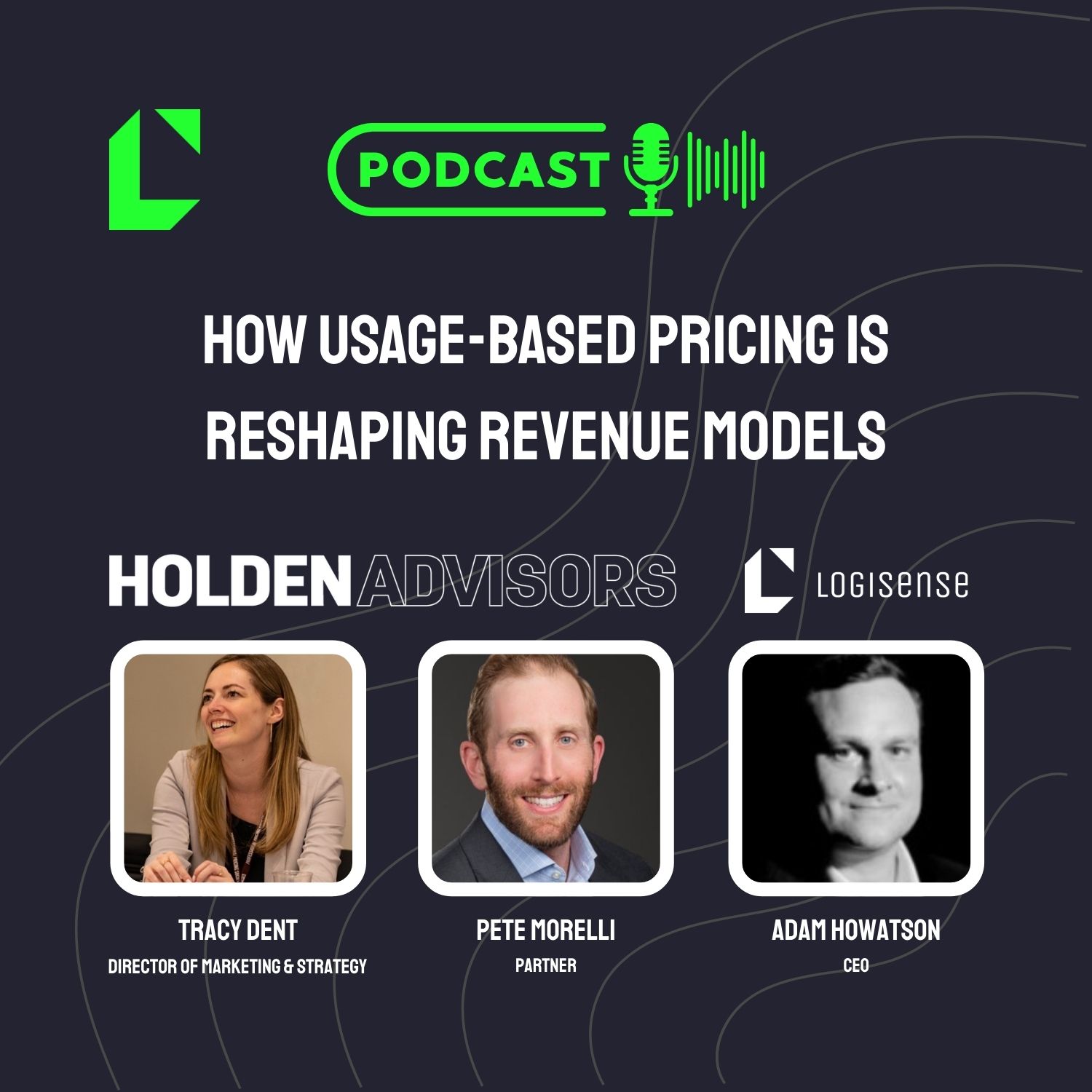
How Usage-Based Pricing Is Reshaping Revenue Models
In this episode of If Prices Could Talk, Adam Howatson, CEO of LogiSense, joins Pete Morelli of Holden Advisors to explore how usage-based pricing is helping companies future-proof their business models and win in markets where expectations are shifting fast.

Continue learning

From Static Pricing to AI Orchestrated Monetization
Ready to Modernize Your Monetization Strategy?
LogiSense Blog
Latest articles
Selecting a real-time usage rating platform requires more than comparing feature lists.
Product teams are under constant pressure to ship faster, add new capabilities, respond to customer demand, and increasingly, embed AI into their...
Every discussion about AI eventually arrives at the same question:
Usage-based pricing is giving SaaS companies more flexibility in how they package and sell their products. Instead of charging every customer the...
For years, network growth was relatively predictable.