
5 Ways Automated Billing Helps Scale Your SaaS Business
As SaaS businesses grow, so does the complexity of managing recurring subscriptions, usage-based charges, customer-specific pricing, taxes, revenue recognition, and financial reporting. What begins as a manageable billing process can quickly become a barrier to growth when handled through spreadsheets, custom scripts, or legacy billing systems.
Today's software companies are monetizing far more than monthly subscriptions. They are charging for API calls, AI tokens, connected devices, storage, transactions, and feature consumption. Product teams are constantly introducing new pricing models, while finance teams are expected to close the books faster and maintain compliance. Managing all of this manually simply isn't sustainable.
An automated billing platform eliminates many of these operational challenges by streamlining billing processes, reducing errors, and giving businesses the flexibility to launch new pricing models without disrupting operations.
Whether you're preparing to expand internationally, introduce usage-based pricing, or simply improve operational efficiency, automated billing provides the foundation needed to scale confidently.
What Is Automated Billing?
Automated billing is the process of using software to manage the entire billing lifecycle with minimal manual intervention. Instead of relying on spreadsheets or disconnected systems, automated billing platforms calculate charges, generate invoices, collect payments, recognize revenue, and provide financial reporting automatically.
For SaaS companies, this means finance, product, sales, and operations teams can spend less time managing billing and more time focusing on innovation and growth.
Beyond improving efficiency, automated billing enables businesses to support increasingly sophisticated pricing strategies, including:
- Subscription billing
- Usage-based billing
- Hybrid pricing models
- Tiered pricing
- Consumption-based pricing
- Prepaid credits
- Customer-specific pricing agreements
The ability to adapt pricing without requiring engineering resources has become a significant competitive advantage.
1. Improve Operational Efficiency and Billing Accuracy
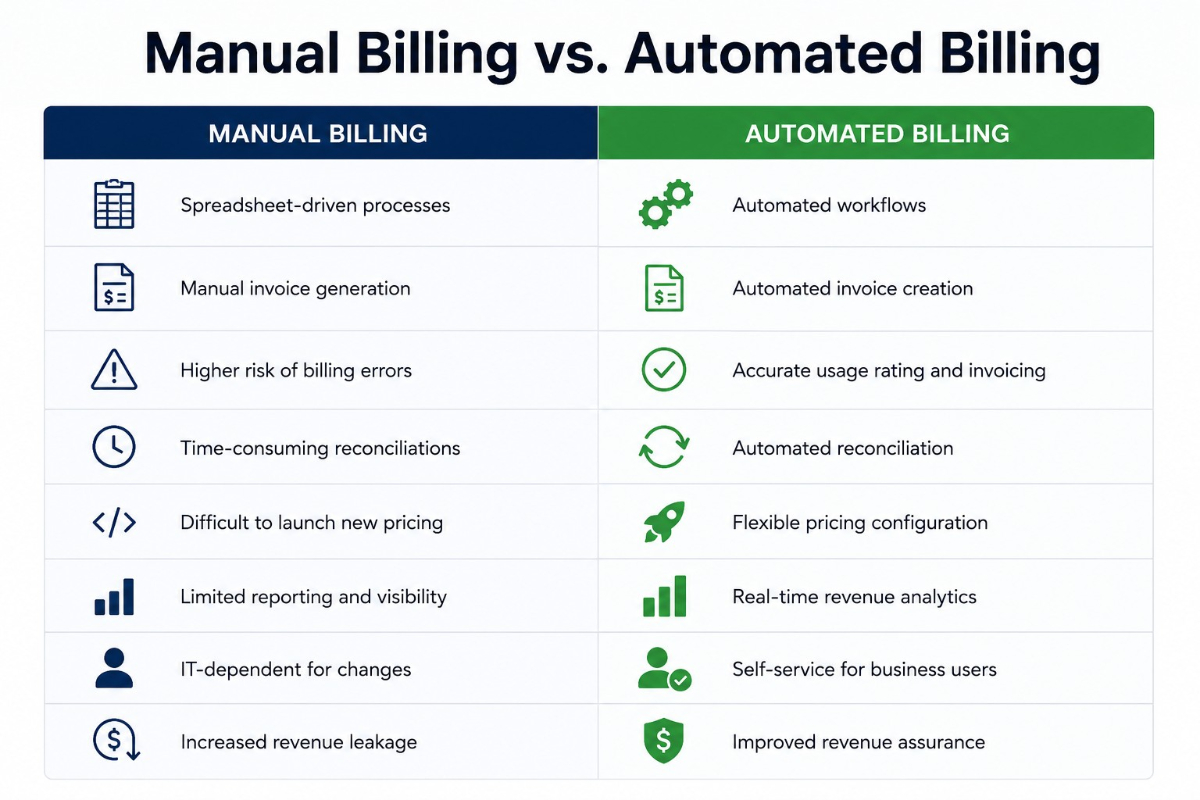
Manual billing processes become increasingly difficult to manage as customer numbers grow. Finance teams often spend countless hours reconciling invoices, correcting billing errors, processing adjustments, and validating usage records.
These manual processes introduce unnecessary risk. Billing inaccuracies can delay payments, increase support tickets, damage customer trust, and ultimately impact revenue.
Automated billing platforms streamline repetitive tasks by:
- Automatically collecting usage data
- Rating usage accurately
- Generating invoices
- Applying discounts and promotions
- Managing recurring billing schedules
- Processing taxes
- Sending payment reminders
Automation also reduces the likelihood of human error while giving finance teams greater confidence in every invoice that leaves the business.
Instead of spending valuable time fixing billing issues, finance teams can focus on strategic planning and business performance.
2. Launch New Pricing Models Without Engineering Bottlenecks
Customer expectations continue to evolve. Many buyers now expect pricing that reflects the value they receive rather than paying a fixed monthly subscription regardless of usage.
Businesses are increasingly introducing:
- Usage-based pricing
- Hybrid subscription models
- AI consumption pricing
- Credit-based billing
- Tiered usage plans
- Bundled services
Unfortunately, many legacy billing systems require significant development work every time pricing changes.
This slows innovation and often forces product teams to compromise on pricing simply because the billing platform cannot support new ideas.
An automated billing platform gives product and commercial teams the flexibility to launch new offers quickly without requiring extensive engineering effort.
This allows businesses to experiment with pricing, respond to customer demand, and bring new products to market much faster.
3. Reduce Revenue Leakage
Revenue leakage is one of the most overlooked challenges facing growing SaaS businesses.
It often occurs when billable usage is missed, pricing rules are applied incorrectly, manual adjustments are overlooked, or disconnected systems fail to capture every customer transaction.
Even small billing discrepancies can accumulate into significant revenue losses as customer volumes increase.
Automated billing platforms help eliminate these issues by accurately capturing, rating, and invoicing every billable event.
They also improve revenue assurance by providing:
- Accurate usage collection
- Automated rating
- Complete audit trails
- Exception reporting
- Billing validation
- Automated reconciliations
By reducing manual intervention, businesses can improve billing accuracy while ensuring they recognize the revenue they've earned.
4. Gain Real-Time Business Insights
Billing data provides far more than invoices.
It offers valuable insight into customer behavior, product adoption, pricing performance, and long-term revenue growth.
Modern billing platforms give organizations access to real-time analytics that help answer important business questions, including:
- Which pricing plans generate the highest revenue?
- Which customers are expanding their usage?
- Where is churn increasing?
- Which services are underutilized?
- How much recurring revenue can we forecast?
- Which products are driving the highest customer lifetime value?
These insights help product, finance, and executive teams make informed decisions backed by accurate data rather than assumptions.
As businesses increasingly adopt AI-driven analytics and predictive forecasting, having reliable billing data becomes even more valuable.
5. Support Growth Without Increasing Operational Complexity
Scaling a SaaS business often means expanding into new regions, serving larger enterprise customers, and introducing increasingly sophisticated pricing models.
Unfortunately, many businesses discover that their billing infrastructure cannot keep pace.
Instead of enabling growth, billing becomes an operational bottleneck that requires manual workarounds and increasing engineering support.
Automated billing platforms are designed to scale alongside your business by supporting:
- Multiple currencies
- Global taxation
- Subscription and usage-based billing
- Customer-specific contracts
- Revenue recognition
- Complex pricing models
- High-volume transaction processing
Rather than replacing billing systems every few years, organizations can build a monetization foundation capable of supporting future growth.
Manual Billing vs. Automated Billing
How Automated Billing Supports Modern SaaS Monetization
Billing is no longer simply a finance function.
It has become a strategic capability that directly impacts customer experience, product innovation, and revenue growth.
Whether you're introducing AI-powered services, monetizing APIs, launching connected devices, or expanding globally, your billing platform needs to evolve alongside your business.
Modern automated billing enables organizations to:
- Experiment with new pricing models faster
- Launch products without billing constraints
- Improve financial visibility
- Reduce operational costs
- Deliver better customer experiences
- Scale revenue operations confidently
Companies that view billing as a strategic growth platform rather than a back-office necessity are better positioned to adapt as markets continue to evolve.

Continue learning

Mastering RevRec for Usage Based Billing
Ready to Modernize Your Billing Strategy?
LogiSense Blog
Latest articles
Selecting a real-time usage rating platform requires more than comparing feature lists.
Product teams are under constant pressure to ship faster, add new capabilities, respond to customer demand, and increasingly, embed AI into their...
Every discussion about AI eventually arrives at the same question:
Usage-based pricing is giving SaaS companies more flexibility in how they package and sell their products. Instead of charging every customer the...
For years, network growth was relatively predictable.