

7 Common SaaS Billing Mistakes to Avoid
For today's SaaS companies, billing is no longer just a back-office function. It has become a strategic capability that influences revenue growth, customer experience, product innovation, and operational efficiency.
As software businesses adopt subscription, usage-based, and hybrid pricing models, billing complexity increases. Product teams want the freedom to experiment with pricing. Finance teams need accurate revenue recognition and reporting. Customers expect transparent invoices, flexible payment options, and frictionless purchasing experiences.
Unfortunately, many organizations discover that their billing infrastructure cannot keep pace with these evolving requirements. What begins as a simple subscription billing process often becomes a collection of manual workarounds, spreadsheets, custom integrations, and engineering effort that slows innovation and creates unnecessary risk.
The good news is that many of the most common billing challenges are preventable.
In this article, we'll explore seven common SaaS billing mistakes, explain why they matter, and share practical strategies to help your business build a billing operation that supports long-term growth.
SaaS Billing Mistakes at a Glance
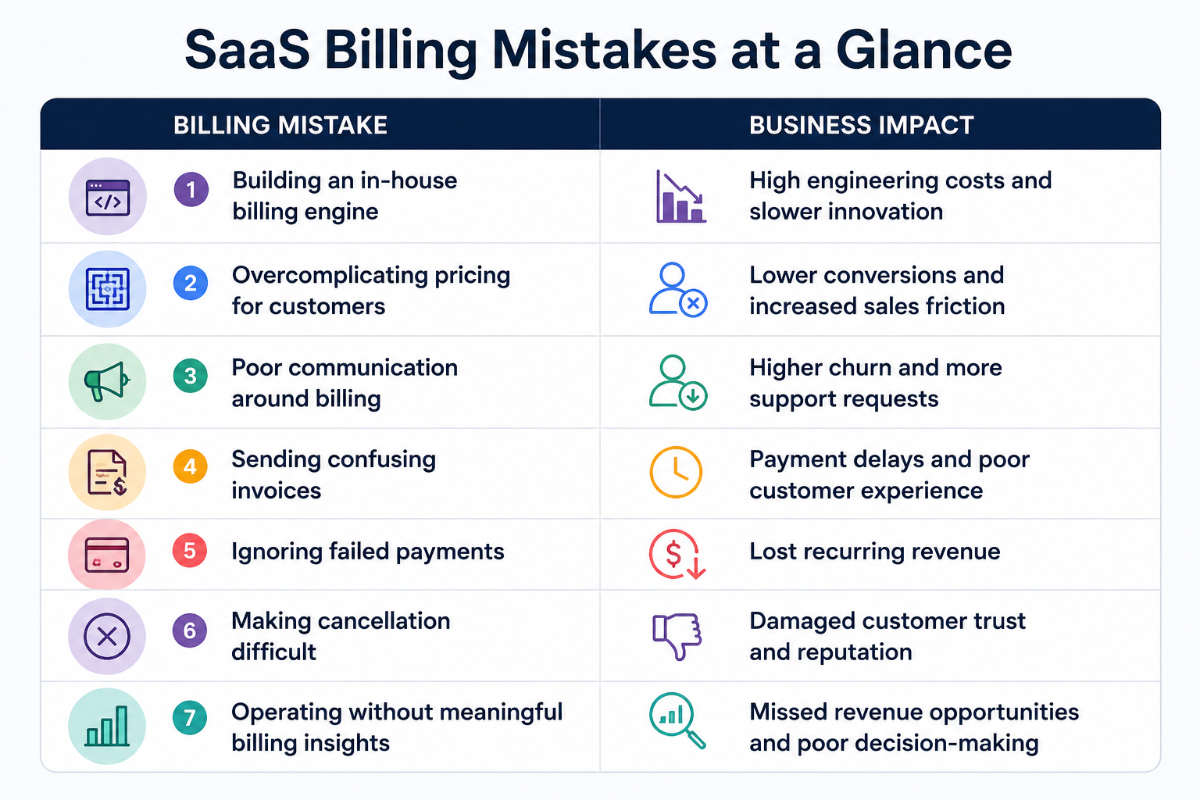
1. Building an In-House Billing Engine
Many SaaS companies begin with a custom billing solution because their pricing model appears straightforward. As the business grows, however, billing requirements become significantly more complex.
Supporting annual and monthly subscriptions, usage-based pricing, prepaid credits, enterprise contracts, discounts, partner agreements, taxation, revenue recognition, and multiple currencies often requires continuous engineering investment.
Instead of focusing on product innovation, development teams become responsible for maintaining billing infrastructure.
Building a billing platform internally also introduces technical debt. Every pricing change, new product launch, or market expansion requires additional development work, increasing both cost and operational risk.
Rather than asking whether your team can build a billing engine, ask whether maintaining one is the best use of your engineering resources.
A purpose-built monetization platform enables your team to launch new pricing models without repeatedly rebuilding billing logic, allowing developers to focus on the products that differentiate your business.
2. Making Pricing More Complicated Than It Needs to Be
Modern pricing models are becoming increasingly sophisticated. Many SaaS companies now combine subscriptions with usage-based charges, feature tiers, prepaid balances, or AI consumption.
Complex pricing itself is not the problem.
The challenge arises when customers struggle to understand what they're buying or how they'll be charged.
Clear pricing improves customer confidence, shortens sales cycles, and reduces billing disputes. Whether your business charges by subscription, API call, transaction, device, or AI token, customers should always understand how pricing works before they purchase.
The most successful pricing strategies balance flexibility for the business with simplicity for the customer.
3. Failing to Communicate Billing Changes Clearly
Unexpected invoices are one of the fastest ways to lose customer trust.
Customers appreciate transparency throughout the billing lifecycle, especially when subscriptions renew automatically, pricing changes, or usage exceeds expected thresholds.
Providing proactive communication through renewal reminders, usage notifications, payment confirmations, and threshold alerts helps eliminate surprises while reducing support requests.
An effective billing platform should automate these communications, ensuring customers always understand what they are being charged and why.
4. Sending Confusing Invoices
Invoices should reinforce customer confidence, not generate support tickets.
If customers cannot easily understand the services they consumed, the pricing applied, or how the total amount was calculated, collections become slower and customer satisfaction declines.
This becomes even more important for businesses offering usage-based services, where customers may consume thousands or even millions of transactions each month.
Detailed invoices that clearly break down subscriptions, usage charges, discounts, taxes, and credits provide greater transparency while reducing disputes.
Clear invoices also help finance teams answer customer questions more efficiently and improve the overall payment experience.
5. Ignoring Failed Payments
Failed payments represent one of the largest sources of preventable recurring revenue loss.
Expired payment methods, temporary bank issues, or insufficient funds do not necessarily indicate that customers intend to cancel their subscriptions.
Without automated retry logic, payment reminders, and dunning workflows, businesses can lose valuable recurring revenue unnecessarily.
Automating payment recovery helps reduce involuntary churn while improving cash flow and minimizing manual collections.
As your customer base grows, automated payment recovery becomes an essential component of scalable billing operations.
6. Making Cancellation Difficult
Some companies attempt to reduce churn by making cancellation intentionally difficult.
While this may delay customer departures temporarily, it often damages trust and creates negative customer experiences that impact referrals and future business.
Instead, treat cancellations as an opportunity to learn.
Gather customer feedback, understand why customers are leaving, and use those insights to improve your product, pricing, or onboarding experience.
A straightforward cancellation process demonstrates confidence in your product while preserving long-term relationships.
Customers who leave on good terms are far more likely to return in the future.
7. Operating Without Meaningful Billing Insights
Billing data contains valuable insights that extend far beyond finance.
Understanding customer usage patterns, expansion opportunities, pricing performance, failed payments, churn trends, and revenue leakage allows organizations to make smarter business decisions.
Without centralized reporting, leadership teams often rely on disconnected spreadsheets and manual reconciliation to understand business performance.
Modern monetization platforms provide real-time visibility into recurring revenue, customer consumption, pricing effectiveness, and operational performance, enabling product, finance, and commercial teams to make informed decisions with confidence.
Billing Should Enable Growth, Not Limit It
As SaaS businesses evolve, billing becomes increasingly connected to every stage of the customer lifecycle.
The ability to launch new pricing models, support enterprise customers, monetize AI services, expand internationally, and adapt to changing market demands depends on having a billing platform that is flexible, scalable, and designed for modern monetization.
Companies that continue relying on manual processes or outdated billing systems often find themselves constrained by technology rather than empowered by it.
Investing in the right billing platform allows organizations to reduce operational complexity, improve customer experiences, accelerate product launches, and unlock new revenue opportunities.

Continue learning

Pricing Without Confusion
Ready to Modernize Your Billing Strategy?
Speak with a LogiSense expert to discover how LogiSense's monetization platform can help you simplify billing, accelerate growth, and future-proof your business.
LogiSense Blog
Latest articles
Selecting a real-time usage rating platform requires more than comparing feature lists.
Product teams are under constant pressure to ship faster, add new capabilities, respond to customer demand, and increasingly, embed AI into their...
Every discussion about AI eventually arrives at the same question:
Usage-based pricing is giving SaaS companies more flexibility in how they package and sell their products. Instead of charging every customer the...
For years, network growth was relatively predictable.