

Monthly vs Annual Subscription Billing – Which Is the Right Choice?
Selecting the right billing frequency is one of the most important decisions a subscription business can make. While monthly and annual subscriptions remain the most common pricing options, today's software companies are increasingly combining subscriptions with usage-based pricing, prepaid credits, and hybrid billing models to better align pricing with customer value.
The right approach depends on your product, target market, customer buying behaviour, and long-term growth strategy. Rather than asking whether monthly or annual billing is better, businesses should ask which model best supports customer acquisition, retention, cash flow, and monetization flexibility.
In this guide, we'll explore the advantages and disadvantages of monthly and annual subscription billing, explain why many businesses now offer both, and discuss how modern billing platforms enable companies to evolve their pricing as they grow.
What Is Subscription Billing?
Subscription billing is a recurring payment model where customers are charged at regular intervals for ongoing access to a product or service. Billing cycles typically occur monthly or annually, although some businesses also offer quarterly or custom billing schedules.
Subscription billing has become the preferred revenue model for many SaaS, communications, AI, IoT, and digital service providers because it delivers predictable recurring revenue while giving customers continuous access to new features and services.
However, recurring billing is only one part of a successful monetization strategy. As businesses introduce consumption-based pricing, AI services, APIs, and connected devices, they increasingly require billing platforms capable of managing multiple pricing models simultaneously.
Monthly Subscription Billing
Monthly subscriptions remain popular because they reduce the barrier to entry for new customers. Lower upfront costs make it easier for prospects to try a product without making a long-term commitment.
This model is particularly effective for product-led growth strategies, self-service software, startups, and businesses targeting small and medium-sized organizations.
Benefits of Monthly Billing
- Lower upfront investment for customers
- Faster customer acquisition
- Greater pricing flexibility
- Easier to introduce new plans and promotions
- Ideal for self-service purchasing
- Better suited to customers with changing requirements
Monthly subscriptions also allow businesses to gather customer feedback quickly and refine their pricing strategy over time.
Challenges of Monthly Billing
The flexibility that customers appreciate can also create challenges for vendors.
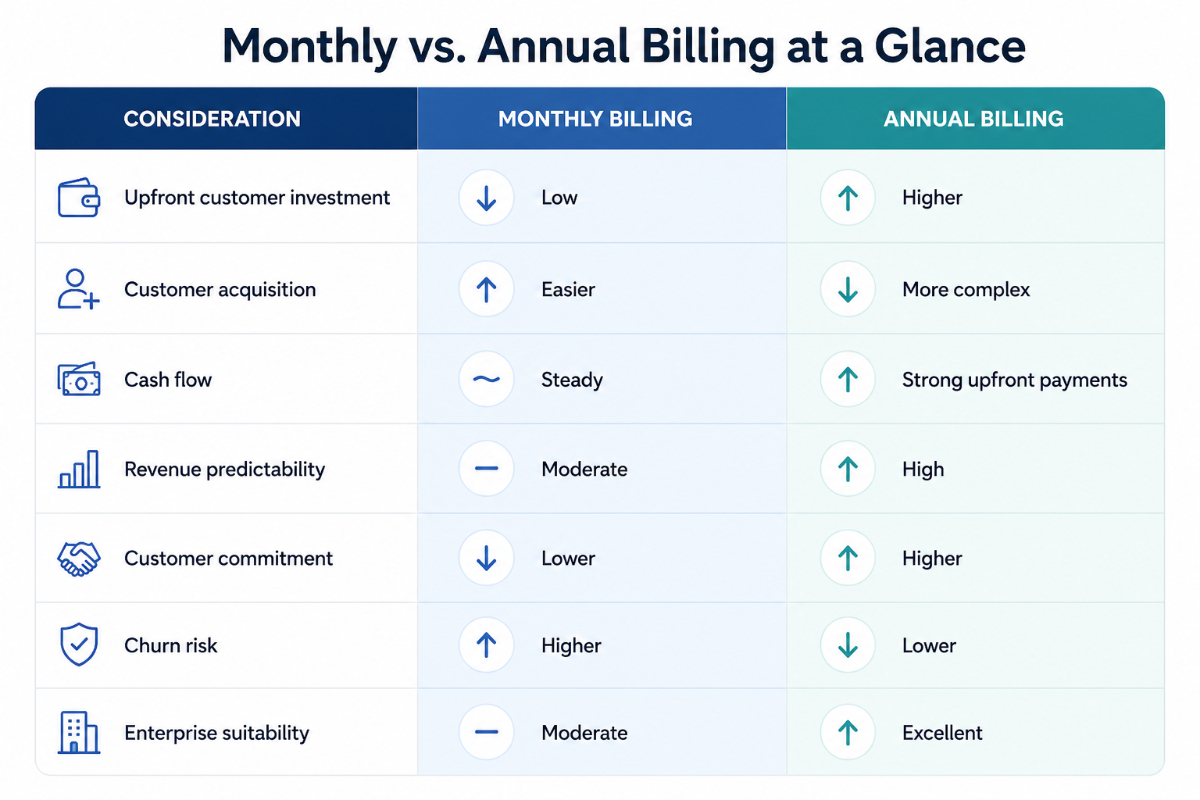
Monthly subscribers typically have higher churn rates, making customer retention an ongoing priority. Businesses must continually demonstrate value to encourage renewals, while finance teams may experience less predictable cash flow compared to annual contracts.
For organizations serving enterprise customers, monthly billing may not align with procurement processes or annual budgeting cycles.
Annual Subscription Billing
Annual subscriptions require customers to commit for a longer period in exchange for discounted pricing or additional value.
This model is common among enterprise software providers because it improves revenue predictability while strengthening long-term customer relationships.
Benefits of Annual Billing
- Improved cash flow through upfront payments
- Lower customer churn
- Greater revenue predictability
- Simplified budgeting for enterprise customers
- Higher customer lifetime value
- Reduced administrative overhead
Annual contracts also create opportunities for stronger customer onboarding, adoption, and long-term success initiatives.
Challenges of Annual Billing
Annual billing presents a higher initial investment for customers, which can increase friction during the buying process. Prospective customers may require additional approvals, procurement reviews, or budget justification before committing.
Businesses must also remember that receiving payment upfront does not mean all revenue can be recognized immediately. Accounting standards such as ASC 606 and IFRS 15 require revenue to be recognized as services are delivered over the life of the contract.
Monthly vs. Annual Billing at a Glance
Why Many Businesses Offer Both
For many organizations, the answer is no longer choosing between monthly or annual billing. Instead, they offer both options to meet the needs of different customer segments.
For example:
- Individual users may prefer monthly subscriptions.
- Small businesses often start with monthly plans before upgrading.
- Enterprise customers frequently negotiate annual contracts.
- Strategic accounts may commit annually while paying monthly.
Providing multiple billing options allows businesses to reduce friction during customer acquisition while maximizing long-term revenue opportunities.
The Rise of Hybrid Billing
The subscription economy has evolved significantly over the past decade.
Many businesses now combine recurring subscriptions with usage-based pricing to better align costs with customer value. Instead of charging a fixed monthly fee alone, companies increasingly bill based on metrics such as API calls, transactions, storage, AI tokens, connected devices, or data consumption.
Examples include:
- Base subscription plus usage charges
- Annual commitments with consumption pricing
- Prepaid usage credits
- Tiered pricing with overage billing
- Subscription bundles with metered services
This hybrid approach provides customers with predictable base pricing while allowing businesses to monetize growth as customer usage increases.
Choosing the Right Billing Strategy
Every business has unique requirements, but the following framework can help guide your decision.
Monthly Billing May Be Best If You:
- Serve small and medium-sized businesses
- Follow a product-led growth strategy
- Offer lower-cost software
- Prioritize rapid customer acquisition
- Require maximum pricing flexibility
Annual Billing May Be Best If You:
- Sell to enterprise customers
- Have lengthy implementation projects
- Depend on procurement processes
- Want predictable recurring revenue
- Focus on long-term customer retention
Hybrid Billing May Be Best If You:
- Monetize AI services
- Bill for APIs or transactions
- Offer communications or telecom services
- Support connected devices or IoT solutions
- Need to combine subscriptions with usage-based pricing
Your Billing Platform Should Support Your Pricing Strategy
Choosing the right billing frequency is important, but your billing platform should never limit how you monetize your products.
As pricing models evolve, businesses need the flexibility to launch new offers, introduce hybrid pricing, support customer-specific contracts, and adapt without relying on costly engineering projects or manual workarounds.
Modern monetization platforms enable organizations to experiment with pricing, respond to changing customer expectations, and scale confidently as their business grows.
Final Thoughts
There is no universal answer to whether monthly or annual subscription billing is the better choice. The right model depends on your customers, your products, and your growth strategy.
For many modern software companies, the most successful approach is not choosing one or the other. It is building a flexible monetization strategy that combines subscriptions, usage-based pricing, and hybrid billing models to align pricing with the value customers receive.
Businesses that can adapt their pricing quickly are better positioned to compete, launch new services, and capture new revenue opportunities in an increasingly consumption-driven economy.

Continue learning

How Companies are Monetizing AI Today
Ready to Modernize Your Billing Strategy?
LogiSense Blog
Latest articles
Selecting a real-time usage rating platform requires more than comparing feature lists.
Product teams are under constant pressure to ship faster, add new capabilities, respond to customer demand, and increasingly, embed AI into their...
Every discussion about AI eventually arrives at the same question:
Usage-based pricing is giving SaaS companies more flexibility in how they package and sell their products. Instead of charging every customer the...
For years, network growth was relatively predictable.